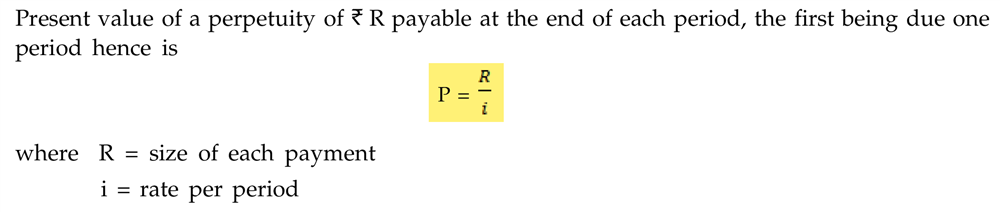
The annuity, whose periodic payment is Rs. R for infinite periods, interest rate being r% per period \(\left(i=\displaystyle\frac{r}{100}\right)\), and periodic payment is made at the end of each payment period, is given by the equation:
Answer & explanation
Correct answer: option 2
The correct answer is Option (2) → \(P=\frac{R}{i}\)
An annuity whose payments go on for ever is a perpetuity. The present value of an ordinary annuity of n payments is
\( \displaystyle P = R\left[\frac{1-(1+i)^{-n}}{i}\right] \)
As \(n \to \infty\), since \(1 + i \gt 1\),
\( \displaystyle (1+i)^{-n} = \frac{1}{(1+i)^n} \to 0 \)
so the present value of the perpetuity is
\( \displaystyle P = \frac{R}{i} \)
CBSE Applied Mathematics (Class XII):
Perpetuity