Read the following passage and answer the next five questions based on it.
Battery or cell converts chemical energy of the redox reaction to electrical energy. In fuel cell (a galvanic cell), the chemical energy of combustion of fuels like H2, ethanol, etc. are directly converted to electrical energy. In a fuel cell, H2 and O2 react to produce electricity, where H2 gas is oxidised at anode and oxygen is reduced at cathode and the reactions involved are
Anode reaction : H2 + 2OH− → 2H2O + 2e−
Cathode reaction : O2 + 2H2O + 4e− → 4OH−
67.2 L of H2 at STP reacts in 15 minutes.
If the entire current produced is used for the electrodeposition of Silver (at.wt. 108 g mol−1) from Silver (I) solution, the amount of silver deposited will be :
Answer & explanation
Correct answer: option 2
The correct answer is Option (2) → 648 g
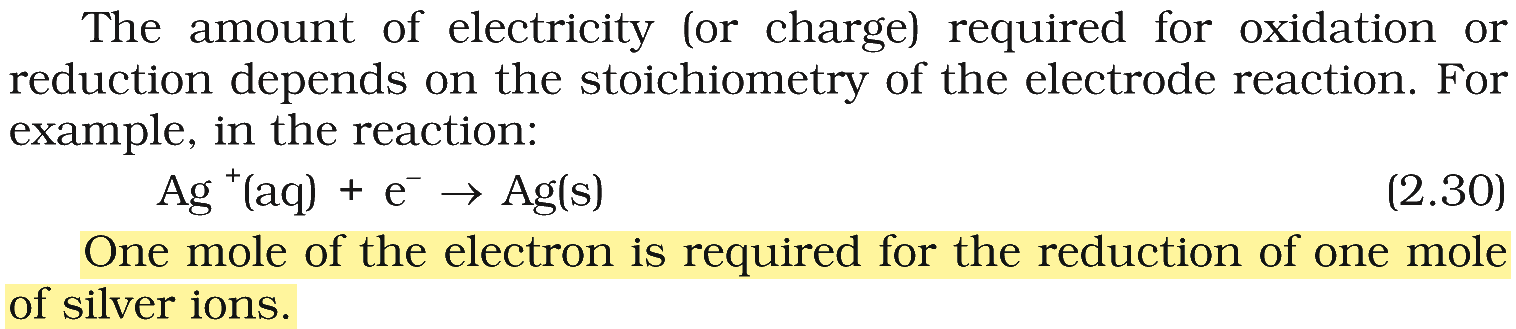
By Faraday’s first law, the amount of substance deposited at an electrode depends on the quantity of electricity passed. The electrode reaction tells how many electrons each ion needs. For silver:
\( \displaystyle \ce{Ag^+(aq) + e^- -> Ag(s)} \)
So one mole of electrons deposits one mole of silver.
The fuel cell oxidises 3 mol of \( \ce{H2} \) (67.2 L / 22.4 L), and each mole of \( \ce{H2} \) gives 2 mol of electrons:
\( \displaystyle n(e^-)=3\times2=6\ \mathrm{mol} \)
\( \displaystyle n(\ce{Ag})=6\ \mathrm{mol} \)
\( \displaystyle m(\ce{Ag})=6\ \mathrm{mol}\times108\ \mathrm{g\,mol^{-1}}=648\ \mathrm{g} \)
So 648 g of silver is deposited.
NCERT (2026-27 edition):
Electrolytic Cells and Electrolysis – …