
CUETMOCK
  • Pricing
  • Mentors
Log inStart freeStart free mocks→

First test, then trust

Try a free CUET mock test.

Join 5,00,000+ students who rehearsed exam day on the exact NTA screen before sitting CUET. On the web and on Android.

Start free mocks →Get the Android app
CUETMOCK

India's #1 CUET Mock Test Platform. Original NCERT-based questions on the exact NTA exam screen — trusted by 5,00,000+ students since CUET 2022.

Get it onGoogle PlayScan to download the CUETMOCK app

Mock tests

  • CUET mock test series
  • Browse all papers
  • Commerce mocks
  • Humanities (Arts) mocks
  • Science mocks
  • Languages & GAT mocks
  • Free practice questions
  • Pricing

Resources

  • CUET exam guide
  • CUET syllabus
  • Universities accepting CUET
  • Expert blogs
  • News & notifications
  • Webinars & counselling
  • CUET score calculator
  • How we estimate your rank
  • FAQs

Company

  • About us
  • Our leadership & team
  • Our toppers
  • Mentors
  • For schools
  • Contact us
  • Terms
  • Privacy
  • Refund policy

Talk to us

+91 7696 6630 56info@cuetmock.comWhatsApp us

Our other platforms

  • JEE Mock — For IIT-JEE aspirants
  • NEET Mock — For NEET aspirants

Newsletter

Exam updates, study material and offers — no spam.

© 2026 NYC Ventures Pvt. Ltd.

701-702, Royal Business Park, Zirakpur, Punjab - 140603

  • Terms of use
  • Privacy policy
  • Refund policy
  • Contact us

iCUETMOCK is an independent preparation platform, not affiliated with the National Testing Agency (NTA). Always check exam details on the official NTA website.

  • Home
  • Mock tests
  • CUET guide
  • Pricing
  • Log in
Home/Practice questions/Biology
BiologyEnvironmental Issues

Arrange the stages of bio magnification of DDT.(A) Fish eating birds…

Arrange the stages of bio magnification of DDT.

(A) Fish eating birds (DDT 25 ppm)
(B) Small fish (DDT 0.5 ppm)
(C) Zooplankton (DDT 0.04 ppm)
(D) Water (DDT 0.003 ppb)
(E) Large fish (DDT 2 ppm)

Choose the correct answer from the options given below:

Answer & explanation+

Correct answer: option 2

The correct answer is Option (2) → (D) → (C) → (B) → (E) → (A)

(A) Fish eating birds (DDT 25 ppm) — fifth and last. They are at the top of the food chain and eat many large fish, so the DDT of all of them collects in their bodies.

(B) Small fish (DDT 0.5 ppm) — third. They feed on zooplankton and keep the DDT of every one they eat.

(C) Zooplankton (DDT 0.04 ppm) — second. They take in DDT from the water and from the phytoplankton they eat.

(D) Water (DDT 0.003 ppb) — first. DDT washed into the lake is at its lowest concentration here; 0.003 parts per billion is far less than any value in ppm.

(E) Large fish (DDT 2 ppm) — fourth. They eat many small fish, so the DDT rises again before it reaches the birds.

The concentration rises at every step because DDT cannot be broken down or excreted; it stays in the body and passes to the next trophic level.

Note: This question is from Chapter 16, Environmental Issues, of the pre-rationalised NCERT book. This chapter is not in the present NCERT book (2026-27). The extract below is from the pre-rationalised edition.

NCERT Extract (Pre-rationalised edition, Chapter 16, Environmental Issues):
Domestic Sewage and Industrial Effluents – “… A few toxic substances, often present in industrial waste waters, can undergo biological magnification (Biomagnification) in the aquatic food chain. Biomagnification refers to increase in concentration of the toxicant at successive trophic levels. This happens because a toxic substance accumulated by an organism cannot be metabolised or excreted, and is thus passed on to the next higher trophic level. This phenomenon is wellknown for mercury and DDT. Figure 16.5 shows biomagnification of DDT in an aquatic food chain. In this manner, the concentration of DDT is increased at successive trophic levels; say if it starts at 0.003 ppb (ppb = parts per billion) in water, it can ultimately reach 25 ppm (ppm = parts per million) in fish-eating birds, through biomagnification.”
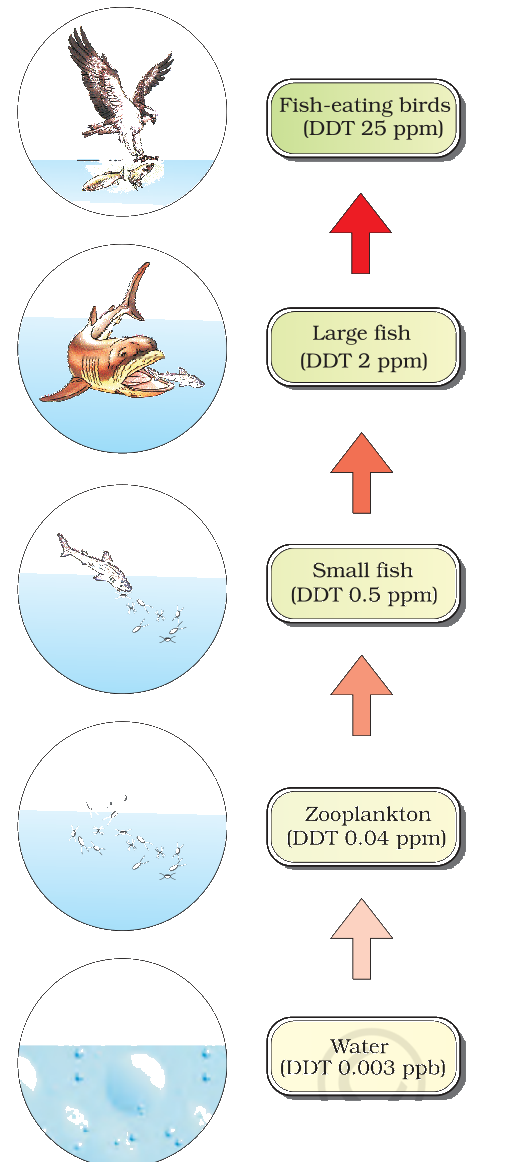
Textbook figure

Figure 16.5 Biomagnification of DDT in an aquatic food chain

Advertisement

Practise more on Environmental Issues

Chapter-wise mocks on the real NTA exam screen, with solutions and your rank. Your first mocks are free.

Start free mocks →

Advertisement

Next questions

  1. Choose the correct Assertive form of the following Exclamatory sentence:How skilfully the mechanic repaired our water pump!English · Kinds of Sentence
  2. The number of vectors of unit length perpendicular to vectors a = (1, 1, 0) and b = (0, 1, 1 ) ?Maths. Section B1 · Vectors
  3. The table given below shows the production of five companies in two years. Years Company Y1 Y2 A 50 100 B 90 120 C 30 80 D 80 50 E 20 40 J1…General Aptitude Test · Quantitative Reasoning
  4. The student replaces the spring with a stiffer one, which gives a larger restoring torque for each radian of twist. Compared with the old g…Physics · Moving Charges and Magnetism
  5. Read the following about tertiary activities carefully. (A) Trade(B) Transport(C) Communication(D) Mining Choose the correct answer from th…Geography · Fundamentals of Human Geography: Tertiary and Quaternary Activities
  6. Select the option in which the two numbers are related in the same way as are the numbers in the given number-pair. (NOTE: Operations shoul…General Aptitude Test · Verbal Reasoning
  7. Which of the following state is NOT associated with iron ore mining?Geography · India-People and Economy: Mineral and Energy resources
  8. What is the minimum value of y = (2x+1)(x+3) ?Maths. Section A · Applications of Derivatives
  9. Select the correct passive form of the given sentence. Swallows build new nests every year.English · Grammar: Active Passive Voice
  10. A simple random sample of 100 items from a population with σ = 8 has a standard error of mean :Applied Maths. Section B2 · Inferential Statistics