
Read the passage and answer the following questions:
Genetic disorders may be grouped into two categories – Mendelian disorders and Chromosomal disorders. Mendelian disorders are mainly determined by alteration or mutation in the single gene. These disorders are transmitted to the offspring on the same lines as we have studied in the principle of inheritance. The pattern of inheritance of such Mendelian disorders can be traced in a family by the pedigree analysis. Most common and prevalent Mendelian disorders are Haemophilia, Cystic fibrosis, Sicklecell anaemia, Colour blindness, Phenylketonuria, Thalassemia, etc. It is important to mention here that such Mendelian disorders may be dominant or recessive. Thalassemia : This is also an autosome-linked recessive blood disease transmitted from parents to the offspring when both the partners are unaffected carrier for the gene (or heterozygous). The defect could be due to either mutation or deletion which ultimately results in reduced rate of synthesis of one of the globin chains (α and β chains) that make up haemoglobin.
Choose the incorrect statements about Down’s syndrome from the following:
A. Down’s syndrome results in the loss of one copy of chromosome 21.
B. Physical, psychomotor and mental development of the affected individual is retarded.
C. The affected individual is tall statured with a small round head.
D. The palm of the affected individual is broad with a characteristic palm crease.
Choose the correct answer from the options given below:
Answer & explanation
Correct answer: option 1
The correct answer is Option (1) → A and C only
Down’s syndrome is a chromosomal disorder, the second category of genetic disorders named in the passage. It is caused by the gain of an extra copy of chromosome 21 (trisomy of 21), which is a case of aneuploidy. The passage itself says nothing about it, so each statement is judged from NCERT.
A. Down’s syndrome results in the loss of one copy of chromosome 21. — False. Down’s syndrome results in the gain of an extra copy of chromosome 21, not a loss. So A is incorrect.
B. Physical, psychomotor and mental development of the affected individual is retarded. — True. NCERT gives this as a feature of the disorder.
C. The affected individual is tall statured with a small round head. — False. The affected individual is short statured with a small round head. So C is incorrect.
D. The palm of the affected individual is broad with a characteristic palm crease. — True. The broad palm with a palm crease is one of the features shown in Figure 4.16.
The incorrect statements are A and C.
NCERT Extract:
Chromosomal Disorders – “… Failure of segregation of chromatids during cell division cycle results in the gain or loss of a chromosome(s), called aneuploidy. For example, Down’s syndrome results in the gain of extra copy of chromosome 21.”
Chromosomal Disorders – “… Down’s Syndrome : The cause of this genetic disorder is the presence of an additional copy of the chromosome number 21 (trisomy of 21). This disorder was first described by Langdon Down (1866). The affected individual is short statured with small round head, furrowed tongue and partially open mouth (Figure 4.16). Palm is broad with characteristic palm crease. Physical, psychomotor and mental development is retarded.”
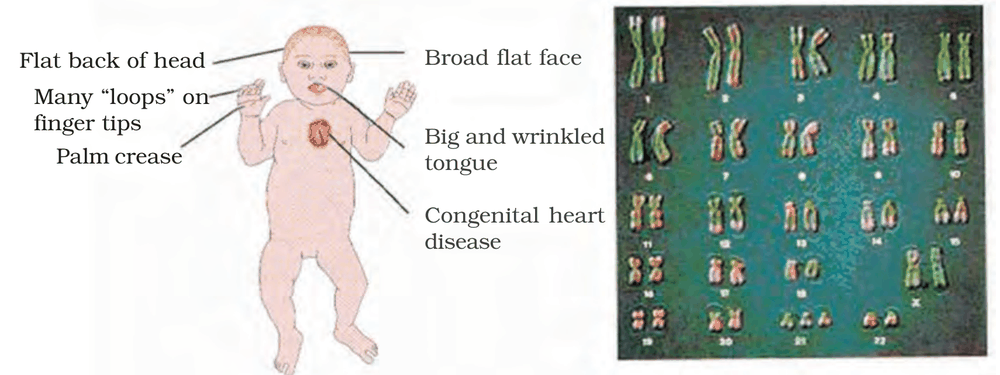
Figure 4.16 A representative figure showing an individual inflicted with Down’s syndrome and the corresponding chromosomes of the individual