If all the increased income is consumed, then the value of MPS will be:
Answer & explanation
Correct answer: option 1
The correct answer is Option (1) → 0
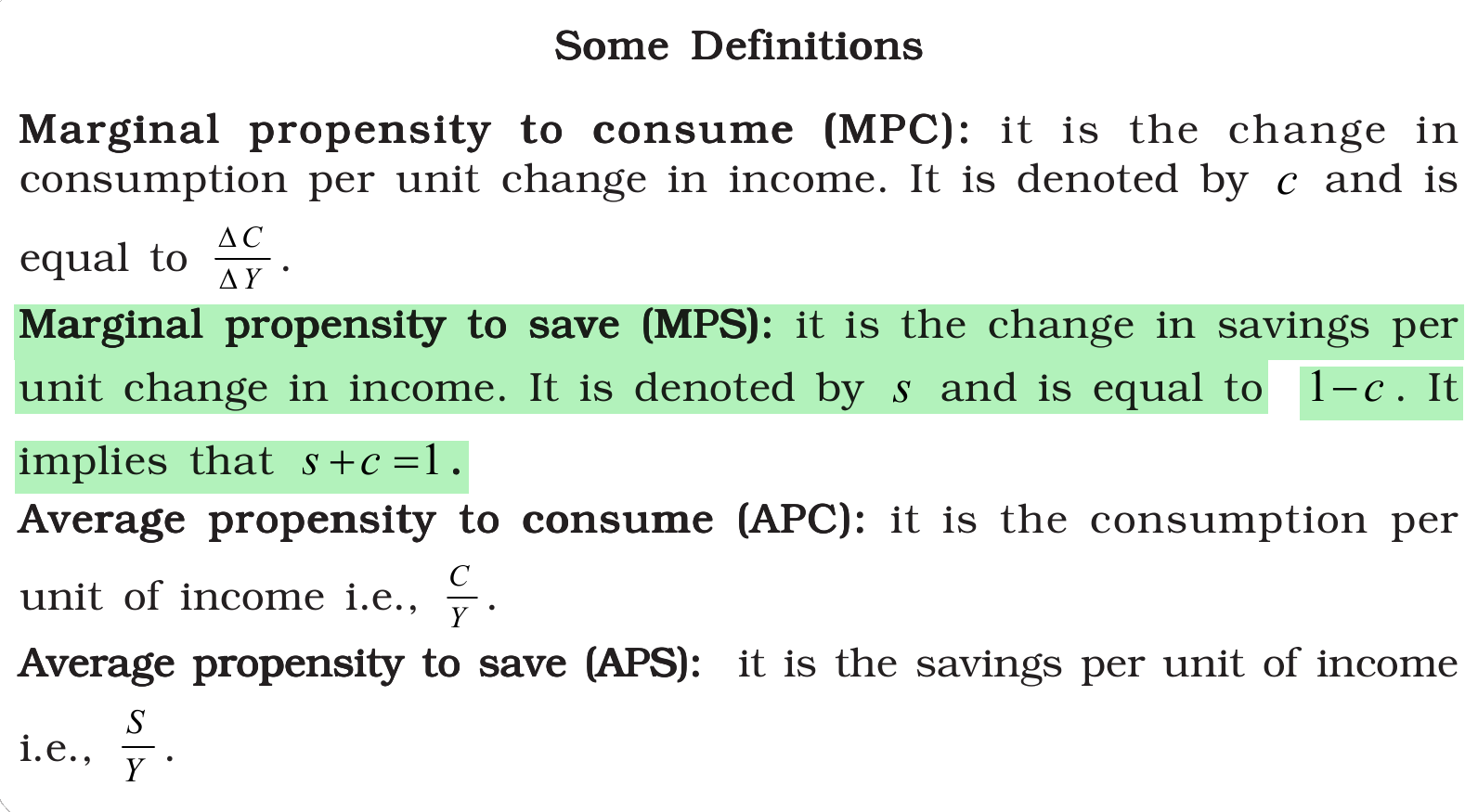
The marginal propensity to consume (MPC) is the change in consumption when income changes by one rupee. The marginal propensity to save (MPS) is the change in saving. Every extra rupee is either consumed or saved, so MPC + MPS = 1.
If all the increased income is consumed, MPC = 1. Then:
MPS = 1 − MPC
= 1 − 1
= 0
NCERT (2026-27): “4.1.1. Consumption … Now, let us look at the value that MPC can take. When income changes, change in consumption (ΔC) can never exceed the change in income (ΔY). The maximum value which c can take is 1. On the other hand consumer may choose not to change consumption even when income has changed. In this case MPC = 0. Generally, MPC lies between 0 and 1 (inclusive of both values). This means that as income increases either the consumers does not increase consumption at all (MPC = 0) or use entire change in income on consumption (MPC = 1) or use part of the change in income for changing consumption (0< MPC<1).”
|