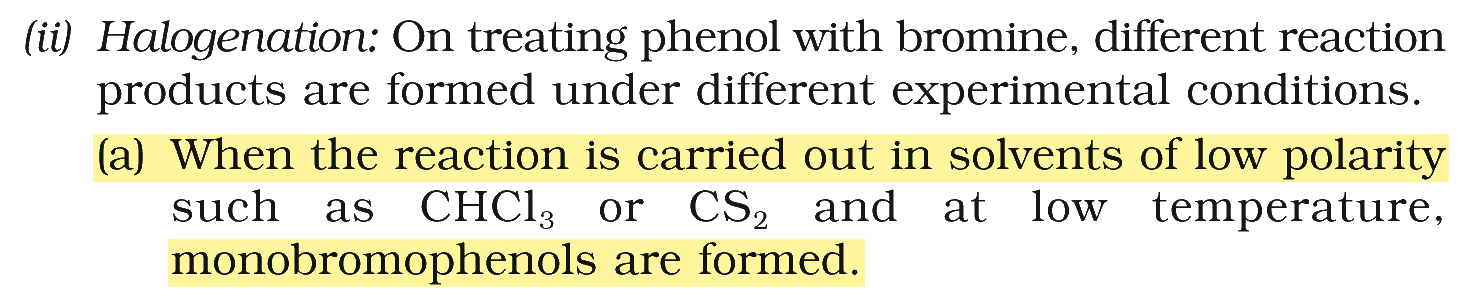
Phenol is brominated in solvent \(CS_2\) at low temperature. The products formed are
Answer & explanation
Correct answer: option 1
The correct answer is Option (1) → Monobromophenols
The OH group strongly activates the benzene ring. In a solvent of low polarity such as \( \ce{CS2} \) or \( \ce{CHCl3} \) and at low temperature, phenol does not ionise and \( \ce{Br2} \) is not polarised much, so only one bromine enters the ring:
\( \displaystyle \ce{C6H5OH + Br2} \xrightarrow[\text{273 K}]{\ce{CS2}} \underset{\text{minor}}{o\text{-}\ce{BrC6H4OH}} + \underset{\text{major}}{p\text{-}\ce{BrC6H4OH}} + \ce{HBr} \)
Why the other options are incorrect
Option (2) Dibromophenols — Incorrect. Dibromo products are not the products under these mild conditions; in \( \ce{CS2} \) the reaction stops after one substitution.
Option (3) Tribromophenols — Incorrect. 2,4,6-tribromophenol (white precipitate) forms with bromine water, where phenol ionises to the more reactive phenoxide ion.
Option (4) Tribromobenzene — Incorrect. Bromination substitutes ring hydrogens and keeps the OH group; no product loses the OH group.
NCERT (2026-27 edition):
Halogenation