Match List-I with List-II
| List-I | List-II |
| (A) GDPMP | (I) NNPFC + NIT |
| (B) GDPFC | (II) NNPMP - NIT |
| (C) NNPMP | (III) GDPFC + NIT |
| (D) NNPFC | (IV) GDPMP - NIT |
Choose the correct answer from the options given below:
Answer & explanation
Correct answer: option 4
The correct answer is Option (4) → (A)-(III), (B)-(IV), (C)-(I), (D)-(II)
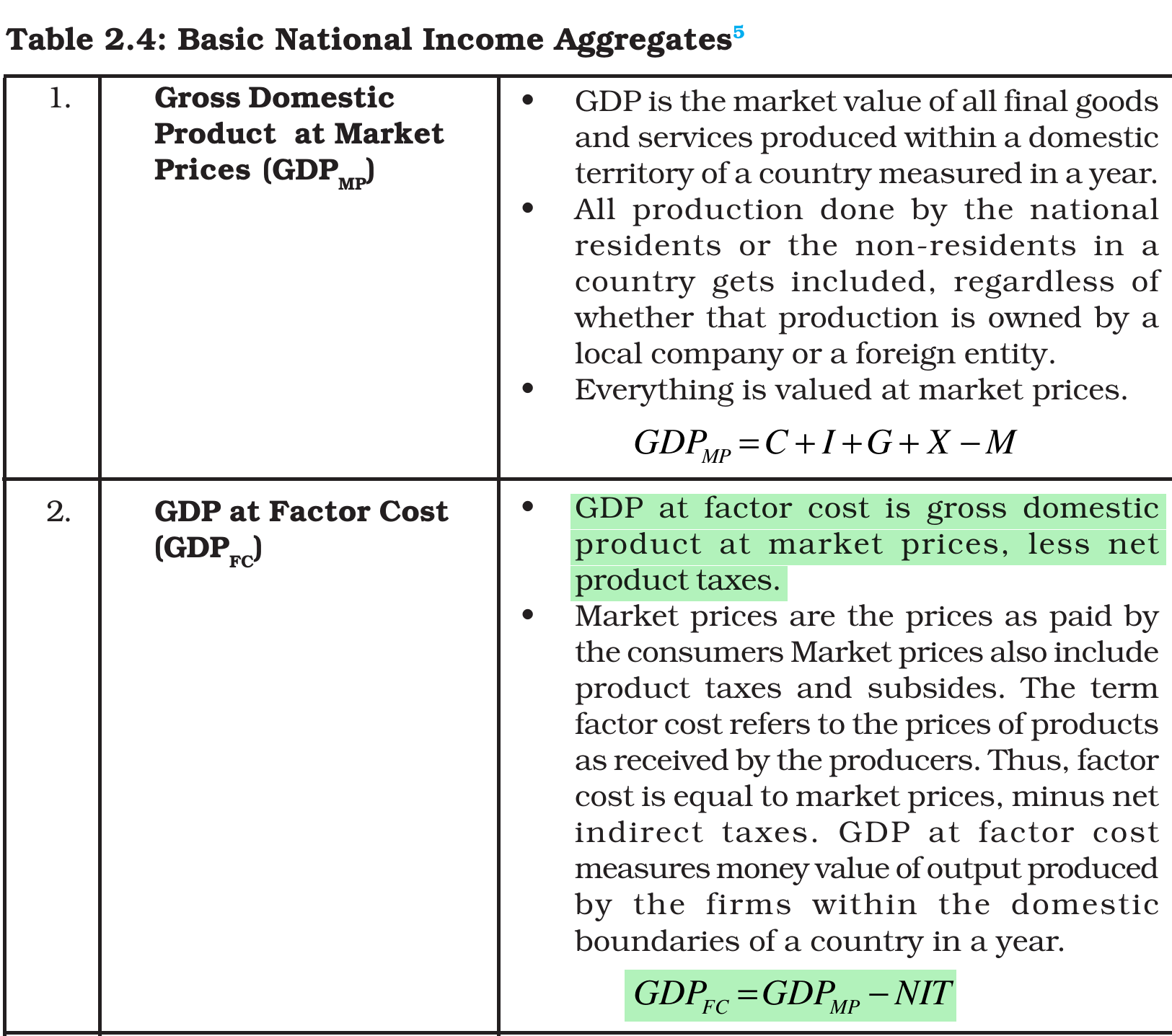
Net indirect taxes (NIT) are indirect taxes minus subsidies. Market prices (MP) include them, and factor cost (FC) does not. So NIT is added to go from FC to MP, and taken away to go from MP to FC.
| List-I | List-II | Reason |
|---|---|---|
| (A) GDPMP | (III) GDPFC + NIT | Adding NIT to gross domestic product at factor cost gives it at market prices. |
| (B) GDPFC | (IV) GDPMP - NIT | Taking NIT out of GDP at market prices gives it at factor cost. |
| (C) NNPMP | (I) NNPFC + NIT | Net national product follows the same rule. Adding NIT gives it at market prices. |
| (D) NNPFC | (II) NNPMP - NIT | Taking NIT out of NNP at market prices gives it at factor cost. This is national income. |
NCERT (2026-27): “2.3 Some Macroeconomic Identities … But market price includes indirect taxes. When indirect taxes are imposed on goods and services, their prices go up. Indirect taxes accrue to the government. We have to deduct them from NNP evaluated at market prices in order to calculate that part of NNP which actually accrues to the factors of production. Similarly, there may be subsidies granted by the government on the prices of some commodities (in India petrol is heavily taxed by the government, whereas cooking gas is subsidised). So we need to add subsidies to the NNP evaluated at market prices. The measure that we obtain by doing so is called Net National Product at factor cost or National Income.
|