
CUETMOCK
  • Pricing
  • Mentors
Log inStart freeStart free mocks→

First test, then trust

Try a free CUET mock test.

Join 5,00,000+ students who rehearsed exam day on the exact NTA screen before sitting CUET. On the web and on Android.

Start free mocks →Get the Android app
CUETMOCK

India's #1 CUET Mock Test Platform. Original NCERT-based questions on the exact NTA exam screen — trusted by 5,00,000+ students since CUET 2022.

Get it onGoogle PlayScan to download the CUETMOCK app

Mock tests

  • CUET mock test series
  • Commerce mocks
  • Humanities (Arts) mocks
  • Science mocks
  • Languages & GAT mocks
  • Free practice questions
  • Pricing

Resources

  • CUET exam guide
  • CUET syllabus
  • Universities accepting CUET
  • Expert blogs
  • News & notifications
  • Webinars & counselling
  • CUET score calculator
  • How we estimate your rank
  • FAQs

Company

  • About us
  • Our leadership & team
  • Our toppers
  • Mentors
  • For schools
  • Contact us
  • Terms
  • Privacy
  • Refund policy

Talk to us

+91 7696 6630 56info@cuetmock.comWhatsApp us

Our other platforms

  • JEE Mock — For IIT-JEE aspirants
  • NEET Mock — For NEET aspirants

Newsletter

Exam updates, study material and offers — no spam.

© 2026 NYC Ventures Pvt. Ltd.

701-702, Royal Business Park, Zirakpur, Punjab - 140603

  • Terms of use
  • Privacy policy
  • Refund policy
  • Contact us

iCUETMOCK is an independent preparation platform, not affiliated with the National Testing Agency (NTA). Always check exam details on the official NTA website.

  • Home
  • Mock tests
  • CUET guide
  • Pricing
  • Log in
Home/Practice questions/Chemistry
ChemistryPhysical: Chemical Kinetics

The figure shows how the concentration of the reactant (a) and of the…

The figure shows how the concentration of the reactant (a) and of the product (b) change with time for a reaction R → P.
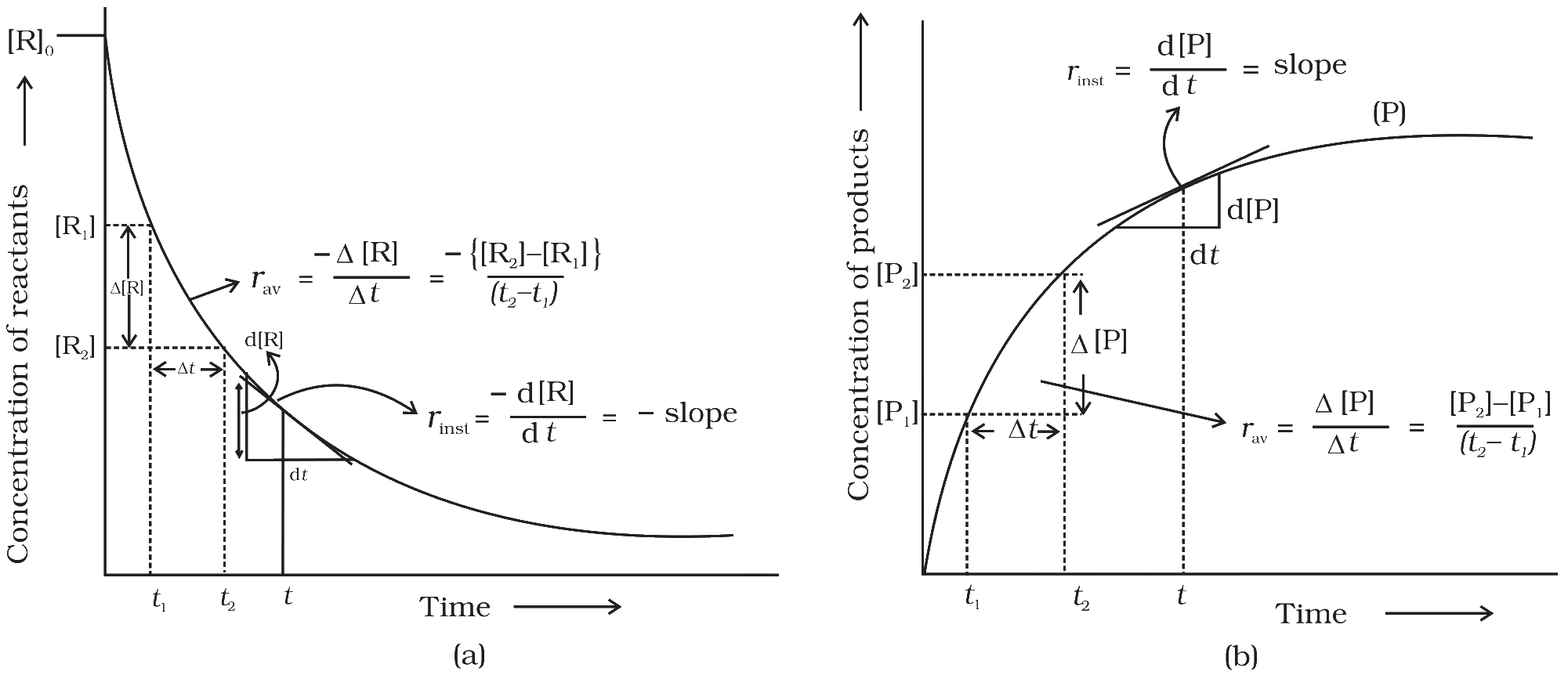
Fig. 3.1 Instantaneous and average rate of a reaction

According to the curves, how does the instantaneous rate of the reaction change as time passes?

Answer & explanation+

Correct answer: option 3

The correct answer is Option (3) → It decreases, because the tangents to the curves become less steep with time.

The figure gives the instantaneous rate at time t as the slope of the tangent drawn to the curve at t.

  • Rate from the tangent — rinst = −d[R]/dt = −slope in (a), and rinst = d[P]/dt = slope in (b).

  • Shape of the curves — Both curves are steep at the start and flatten out as time passes, so a tangent drawn at a later time is less steep. The rate is therefore largest at the start and decreases with time.

Why the other options are incorrect

Option (1) It stays the same throughout the reaction. — Incorrect. A constant rate would give a straight line; both curves bend and flatten, so the slope of the tangent changes with time.

Option (2) It increases, because the concentration of the product increases. — Incorrect. The rate is the slope of the tangent, not the concentration; [P] keeps rising, but curve (b) rises less and less steeply.

Option (4) It increases at first and then decreases. — Incorrect. Both curves are steepest at t = 0; there is no early part where they become steeper.

NCERT (2026-27 edition):
3.1 Rate of a Chemical Reaction – “It can be determined graphically by drawing a tangent at time t on either of the curves for concentration of R and P vs time t and calculating its slope (Fig. 3.1).”

Fig. 3.1

Fig. 3.1: Instantaneous and average rate of a reaction

Advertisement

Practise more on Physical: Chemical Kinetics

Chapter-wise mocks on the real NTA exam screen, with solutions and your rank. Your first mocks are free.

Start free mocks →

Advertisement

Next questions

  1. On what basis do we differentiate public sector from private sector?General Aptitude Test · General Knowledge
  2. Which of the following is NOT a physical stress?Psychology · Meeting Life Challenges
  3. Consider the following statements about hoards found at Harappan sites:(A) Hoards are objects kept carefully by people, often inside contai…History · Ancient India: Bricks, Beads and Bones
  4. ∫limits_0^π / 2 sin 2 x log tan x d x is equal toMaths. Section B1 · Definite Integration
  5. According to Buddhist texts, whose mediation persuaded the Buddha to allow women's admission into the sangha?History · Ancient India: Thinkers, Beliefs and Buildings
  6. Arrange the following into a meaningful sentence (A) there are some species (B) their own nests (C) do you know that (D) of birds that do n…English · Arrange in Meaningful Sequence
  7. he value of f(0) so that the function f(x)=(2x-sin^-1x)/(2x+tan^-1x) is continuous at each point on its domain isMaths. Section B1 · Continuity and Differentiability
  8. The first and foremost role of money is that it acts as a :Economics · Macro Economics: Money and Banking
  9. Under the indirect method of determining net cash flow from operating activities, how are investing and financing incomes treated?Accountancy Part B · Cash Flow Statement
  10. If U + V = 80 and U : V = 5 : 3, then what is the value of U - V?General Aptitude Test · Numerical Ability