
Take the statements below to be true, even if they differ from known facts. Which of the conclusions follow logically from them?
Statements:
1. No carpet is a curtain.
2. All rugs are curtains.
3. All rugs are mats.
Conclusions:
I. Some mats are not carpets.
II. Some carpets are mats.
III. No carpet is a mat.
Answer & explanation
Correct answer: option 1
The correct answer is Option (1) → Only conclusion I and either conclusion II or conclusion III follow
A conclusion follows only if it is true in every diagram that fits the statements; each class named in a statement is taken to have members. When two conclusions do not follow on their own, but in every diagram exactly one of them is true, they count as “either one or the other follows”.
“No carpet is a curtain”: the circles of carpets and curtains do not touch
“All rugs are curtains”: the circle of rugs lies inside the circle of curtains
“All rugs are mats”: the circle of rugs also lies inside the circle of mats; the mats outside the curtains may or may not meet the carpets
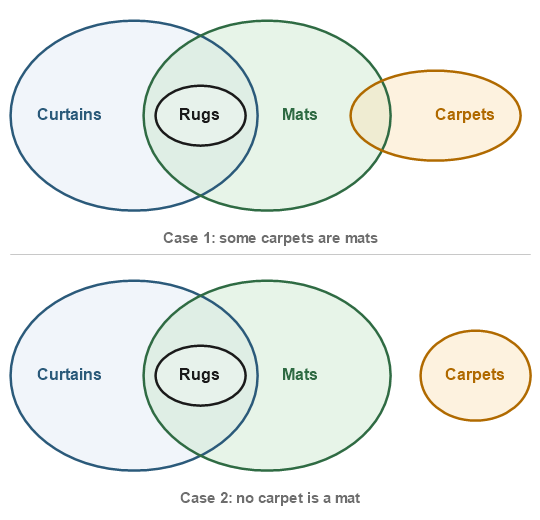
Conclusion I: Some mats are not carpets. — Follows. The rugs are mats; they are also curtains, and no curtain is a carpet; so these mats are not carpets.
Conclusion II: Some carpets are mats. — Does not follow on its own. In case 2 the carpets and mats do not meet, so it is false there.
Conclusion III: No carpet is a mat. — Does not follow on its own. In case 1 some carpets meet the mats outside the curtains, so it is false there.
Carpets and mats either meet or they do not; there is no third case. So exactly one of II and III is always true: conclusion I follows, and either conclusion II or conclusion III follows.