
Read the passage carefully and answer the Questions.
Aldehydes and ketones are important organic compounds prepared mainly by oxidation of alcohols. Primary alcohols give aldehyde and secondary alcohols yield ketones. Aldehydes can also be formed by partial reduction of acid chlorides, reduction of esters or by Gattermann-Koch reaction. Ketones are prepared via Friedel-Craft's acylation, hydration of alkyne and reaction of Grignard's reagent with nitriles. Chemically, aldehydes and ketones are reactive in nature due to the carbonyl group and undergo nucleophilic addition reactions. Aldehydes are more reactive than ketones and can be oxidized to carboxylic acids, while both can be reduced to alcohols or hydrocarbons and exhibit condensation reaction.
The correct structure of the product in the following reaction is;

Answer & explanation
Correct answer: option 1
The correct answer is Option (1) → **
The Reaction: Nitrile + Grignard Reagent
The reaction involves the nucleophilic attack of the phenyl group ($C_{6}H_{5}$) from the Grignard reagent onto the electrophilic carbon of the nitrile ($C_{2}H_{5}-CN$).
- Nucleophilic Attack: The Phenyl magnesium bromide ($C_{6}H_{5}MgBr$) attacks the carbon of the ethyl cyanide ($C_{2}H_{5}CN$) to form an imine salt.
- Acid Hydrolysis: Treatment with $H_{3}O^{+}$ hydrolyzes the imine intermediate into a ketone.
Step-by-Step Product Formation
- Starting Material: Ethyl cyanide ($CH_{3}-CH_{2}-C\equiv N$)
- Reagent: Phenyl magnesium bromide ($Ph-MgBr$)
- Final Product: The nitrile carbon becomes the carbonyl carbon ($C=O$). One side remains the ethyl group ($C_{2}H_{5}$), and the other side becomes the phenyl group ($C_{6}H_{5}$).
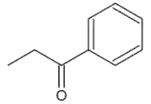
The resulting structure is Propiophenone (1-phenylpropan-1-one):
$C_{2}H_{5} - \overset{\displaystyle O}{\parallel \atop C} - C_{6}H_{5}$
Option Analysis
- Option 1: Shows a 3-carbon chain (ethyl) attached to a carbonyl, which is attached to a benzene ring. This is the mathematically and chemically correct product.
- Option 2: Shows a benzyl group ($CH_2-Ph$) attached to an acetyl group. This would require the starting material to be benzyl cyanide, not ethyl cyanide.
- Option 3: Is an aldehyde (incorrect).
- Option 4: Is an alcohol (incorrect; this would only happen if a second equivalent of Grignard attacked the ketone).