
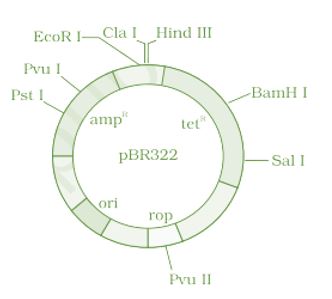
The given figure is the diagrammatic representation of the vector pBR322.Which one of the following option correctly identifies its components ?
Answer & explanation
Correct answer: option 4
The correct answer is Option (4) → ampR, tetR - antibiotic resistance genes
pBR322 is an E. coli cloning vector. Its map shows an origin of replication (ori), the rop gene, two antibiotic resistance genes and several restriction sites where foreign DNA can be joined.
Option (1) ori - codes for the proteins involved in the replication of the plasmid — Incorrect. The ori is the sequence from where replication starts, and it also controls the copy number of the linked DNA. The proteins for plasmid replication are coded by rop.
Option (2) rop - sequence from where replication starts — Incorrect. This is the job of ori, not rop. The rop gene codes for the proteins involved in the replication of the plasmid.
Option (3) BamH I, Sal I - selectable markers — Incorrect. BamH I and Sal I are restriction sites, places where a restriction enzyme cuts the vector. A selectable marker is a gene, such as an antibiotic resistance gene.
Option (4) ampR, tetR - antibiotic resistance genes — Correct. ampR (ampicillin resistance) and tetR (tetracycline resistance) are the two antibiotic resistance genes of pBR322. They act as selectable markers for transformants and recombinants.
Note: The line on rop is not in the paragraphs at all; it sits in the caption of Figure 9.4. A figure caption is two lines long and can still hold a whole option, so read it.
NCERT Extract:
Cloning Vectors – “… (i) Origin of replication (ori) : This is a sequence from where replication starts and any piece of DNA when linked to this sequence can be made to replicate within the host cells. This sequence is also responsible for controlling the copy number of the linked DNA.”
Figure 9.4 – “E. coli cloning vector pBR322 showing restriction sites (Hind III, EcoR I, BamH I, Sal I, Pvu II, Pst I, Cla I), ori and antibiotic resistance genes (ampR and tetR). rop codes for the proteins involved in the replication of the plasmid.”