Statement I: The chemical equivalent weight of Mg is half of its atomic mass.
Statement II: The magnesium ion carries a charge of +2.
Answer & explanation
Correct answer: option 1
The correct answer is Option (1) → Both Statement I and Statement II are correct and Statement II is the correct explanation of Statement I
One faraday (one mole of electrons) deposits one chemical equivalent of a metal. How much metal that is depends on how many electrons each cation needs to be reduced.
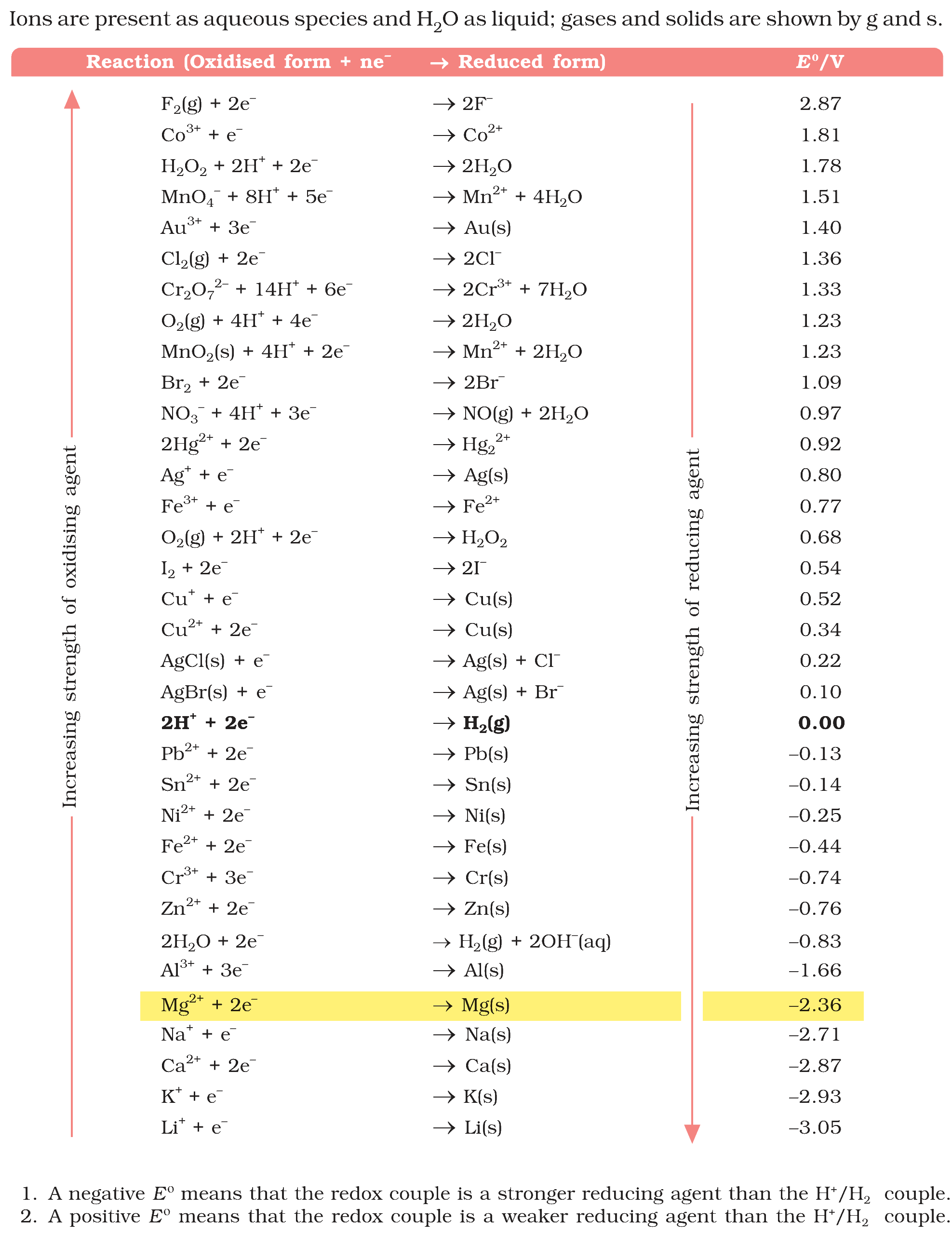
Statement I: The chemical equivalent weight of Mg is half of its atomic mass. — True. Discharging one \( \ce{Mg^2+} \) ion takes two electrons:
\( \displaystyle \ce{Mg^2+ + 2e^- -> Mg} \)
\( \displaystyle \text{Equivalent weight}=\frac{\text{Atomic mass}}{2}=\frac{24}{2}=12 \)
Statement II: The magnesium ion carries a charge of +2. — True.
Configuration: Magnesium (Z = 12) is [Ne]3s2.
Electrons removed: it loses its two 3s electrons to form \( \ce{Mg^2+} \).
Why Statement II explains Statement I?
Statement I is about how much magnesium one faraday deposits; Statement II gives the charge on the ion.
Because the ion is \( \ce{Mg^2+} \), two electrons are needed for each atom deposited, so the atomic mass is divided by 2. The +2 charge is the direct cause of the “half”.
NCERT (2026-27 edition):
Faraday’s Laws of Electrolysis

Table 2.1: Standard Electrode Potentials at 298 K