Arrange the following in decreasing order of the basic character in aqueous phase
(A) Ethanamine
(B) Benzeneamine
(C) Phenylmethanamine
(D) N-methylaniline
Choose the correct answer from the options given below:
Answer & explanation
Correct answer: option 2
The correct answer is Option (2) → (A), (C), (D), (B)
The basic character of an amine comes from the lone pair on nitrogen; anything that makes this lone pair more available makes the amine a stronger base (smaller pKb). Two factors decide the order here:
An alkyl group on nitrogen releases electrons (+I effect) and raises the basic strength.
A benzene ring on nitrogen pulls the lone pair into the ring by resonance, so aryl amines are much weaker bases than ammonia. A benzene ring that is separated from nitrogen by a \( \ce{CH2} \) group cannot do this.
Applying them to the four amines:
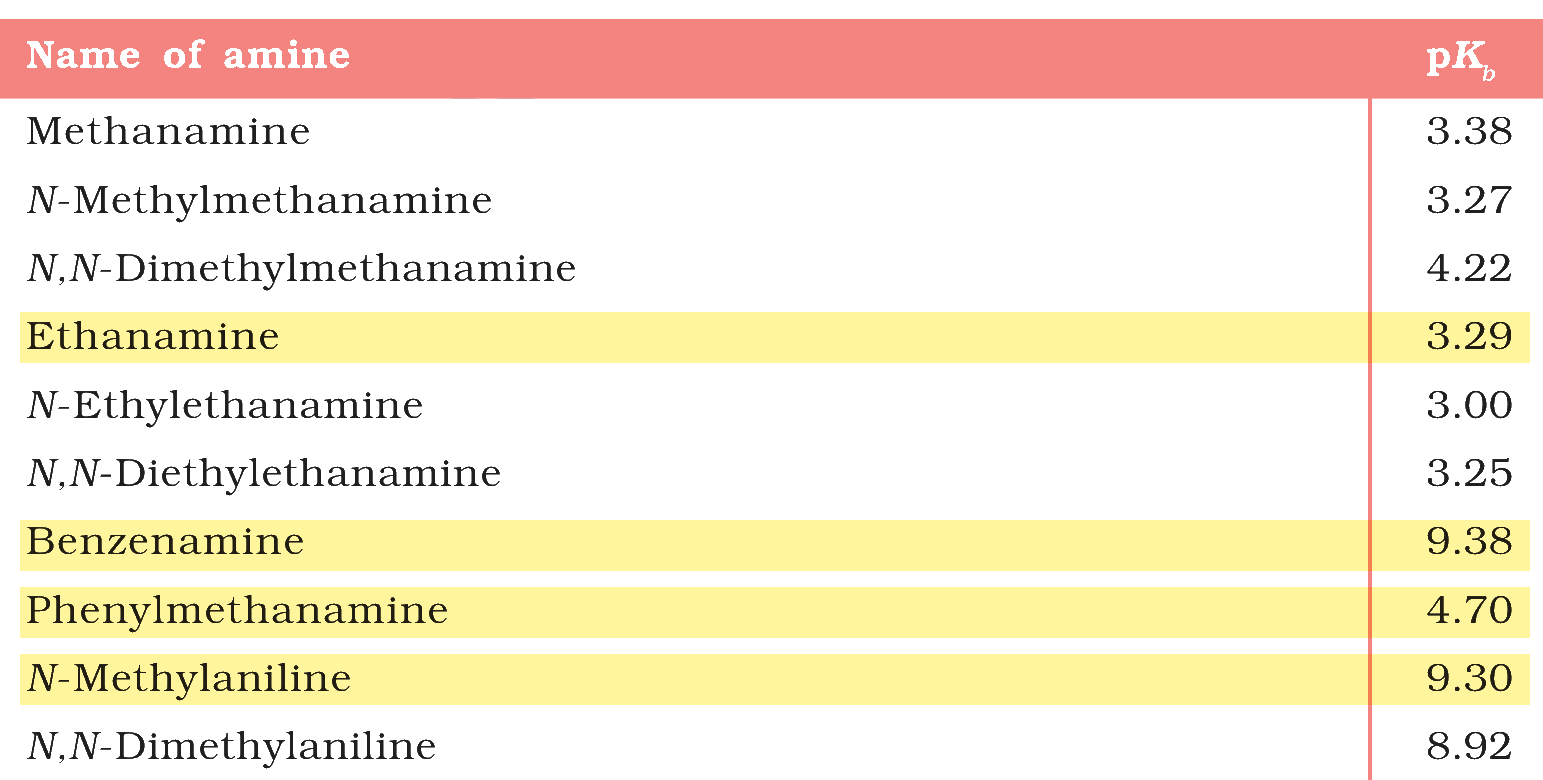
(A) Ethanamine, \( \ce{C2H5NH2} \): an alkylamine with no ring; the strongest base (pKb 3.29).
(C) Phenylmethanamine (benzylamine), \( \ce{C6H5CH2NH2} \): the \( \ce{CH2} \) group keeps the lone pair out of resonance with the ring, so it behaves like an alkylamine; the phenyl group only lowers the basicity slightly by its −I effect (pKb 4.70).
(D) N-methylaniline, \( \ce{C6H5NHCH3} \): the lone pair is delocalised into the ring, but the methyl group pushes some electron density back to nitrogen (pKb 9.30).
(B) Benzenamine (aniline), \( \ce{C6H5NH2} \): delocalisation with no compensating alkyl group; the weakest base (pKb 9.38).
In decreasing order of basic strength:
\( \displaystyle \ce{C2H5NH2} \gt \ce{C6H5CH2NH2} \gt \ce{C6H5NHCH3} \gt \ce{C6H5NH2} \)
Shortcut: The alkylamine (A) is the strongest base and aniline (B), with no alkyl group to help, the weakest. Only Option (2) starts with (A) and ends with (B).
NCERT (2026-27 edition):
Basic Character of Amines – …