Observe the image and answer the following question.
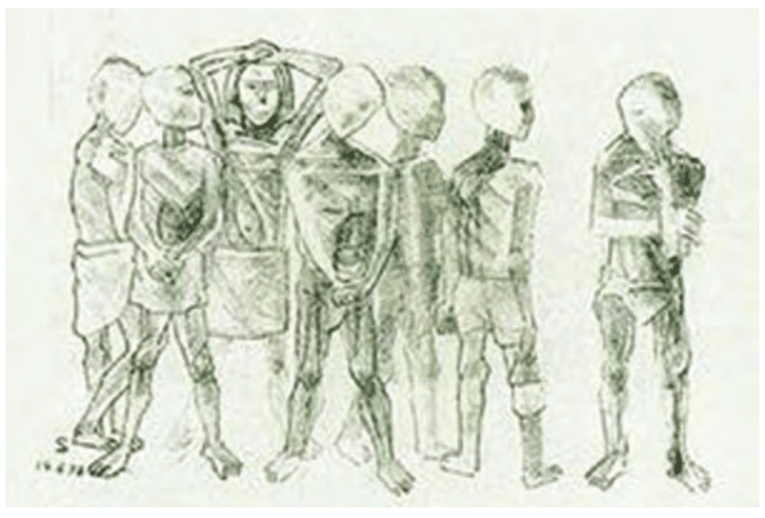
Look at Somnath Hore’s etching Children.
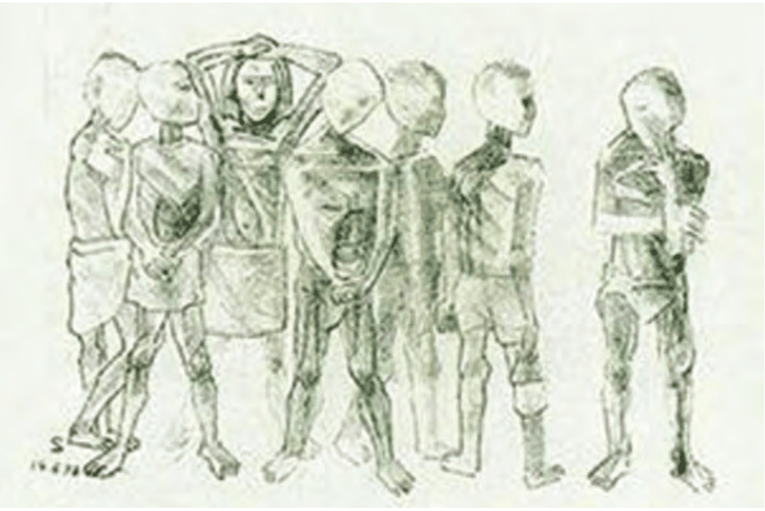
What is the common feature of the figures in this etching?
Answer & explanation
Correct answer: option 3
The correct answer is Option (3) → Linear, with skeletal torsos and stick-like legs
Option (1) Strong musculature revealing bones, veins and flesh — Incorrect. This is Debi Prasad Roy Chowdhury’s Triumph of Labour, whose workers show strong muscles. Hore’s children are thin and starved.
Option (2) Ornate contours with a puppet-like stylisation — Incorrect. This describes Laxma Goud’s Rural South Indian Man–Woman, where the figures have a touch of puppets.
Option (3) Linear, with skeletal torsos and stick-like legs — Correct. Each child is drawn in line, with a skeletal torso and a body resting on two stick-like legs. It shows the effect of the 1943 famine.
Option (4) Flat shapes made by colour patches, not outline — Incorrect. This is Amrita Sher-Gil’s way in Haldi Grinder. Hore’s print is a monochrome etching built from strong lines.
NCERT (2026-27): “Children This is a graphic print on paper done with monochromatic etching with aquatint made by Somnath Hore (1921–2006) in 1958. …This is a close knit composition with five standing figures, having no background, perspective or surrounding situation as the figures are talking to themselves. The figures are linear, each with a skeletal torso of a huge malaria spleen and ribcage for the thorax. Supporting a huge skull, with a small face, the whole body is seen resting on two stick-like legs.…”
|