Read the given paragraph carefully and answer the following questions.
Government Budget
The Indian economy is on a strong wicket and stable footing, demonstrating resilience in the face of geopolitical challenges. The Indian economy has consolidated its post-Covid recovery with policymakers — fiscal and monetary — ensuring economic and financial stability. Nonetheless, change is the only constant for a country with high growth aspirations. For the recovery to be sustained, there has to be heavy lifting on the domestic front because the environment has become extraordinarily difficult to reach agreements on key global issues such as trade, investment and climate. The headline inflation rate is largely under control, although the inflation rate for some specific food items is elevated. The trade deficit was lower in FY24 than in FY23, and the current account deficit for the year is around 0.7% of GDP. In fact, the current account registered a surplus in the last quarter of the financial year. Foreign exchange reserves are ample. Public investment has sustained capital formation in the last several years even as the private sector shed its balance sheet blues and began investing in FY22. Now, it has to receive the baton from the public sector and sustain the investment momentum in the economy. The signs are encouraging. National income data show that non-financial private-sector capital formation, measured in current prices, expanded vigorously.
With reference to the above passage, the current account comprises?
Answer & explanation
Correct answer: option 3
The correct answer is Option (3) → Exports and imports of goods & services plus transfer payments.
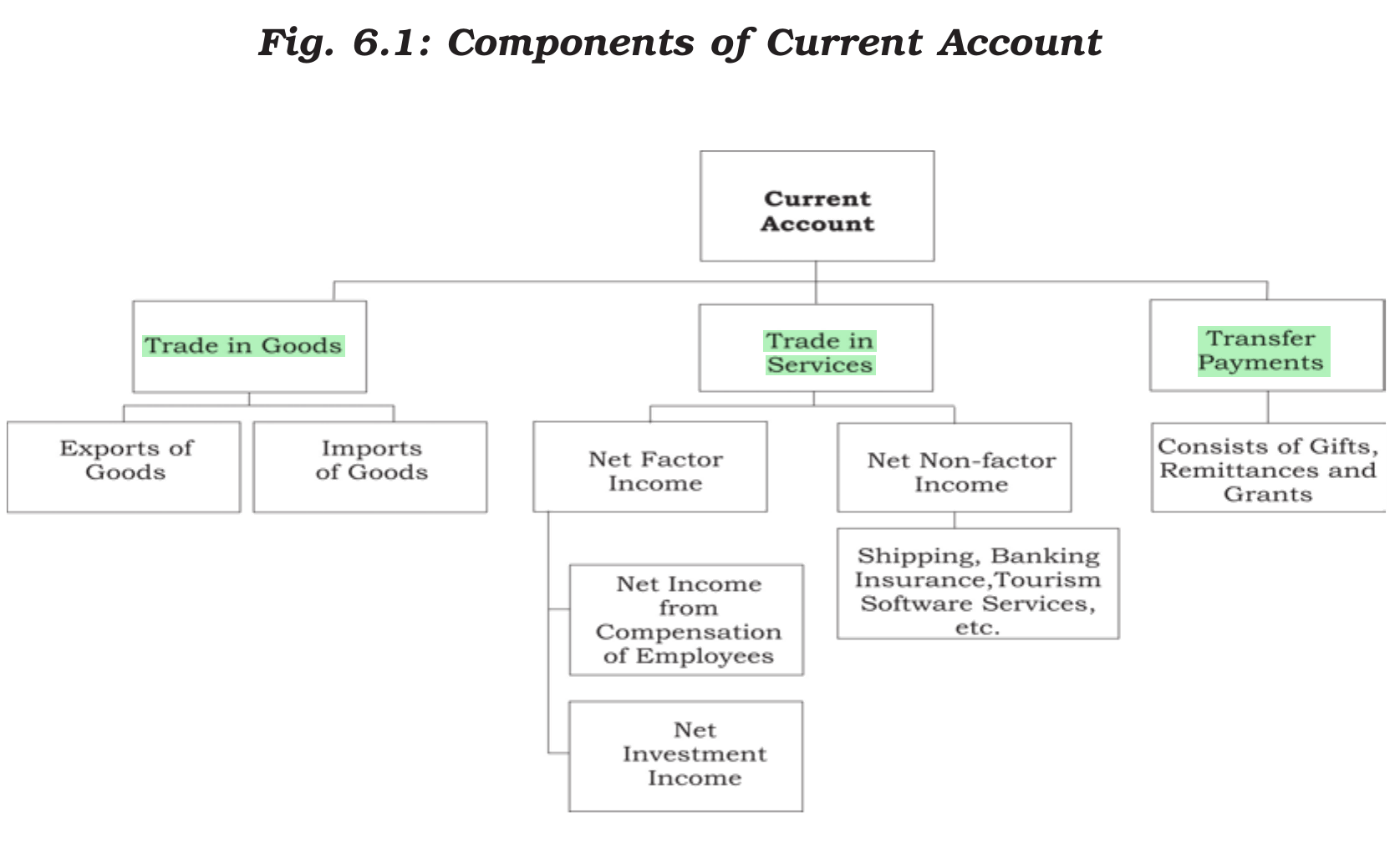
The current account is the record of trade in goods and services and transfer payments. Transfer payments are receipts that residents get free, such as gifts and remittances. Borrowing and other dealings in assets go to the capital account.
Option (1) Exports and Imports of visible items only. — Incorrect. Visible items are goods. The current account also records services and transfers, which are called invisibles.
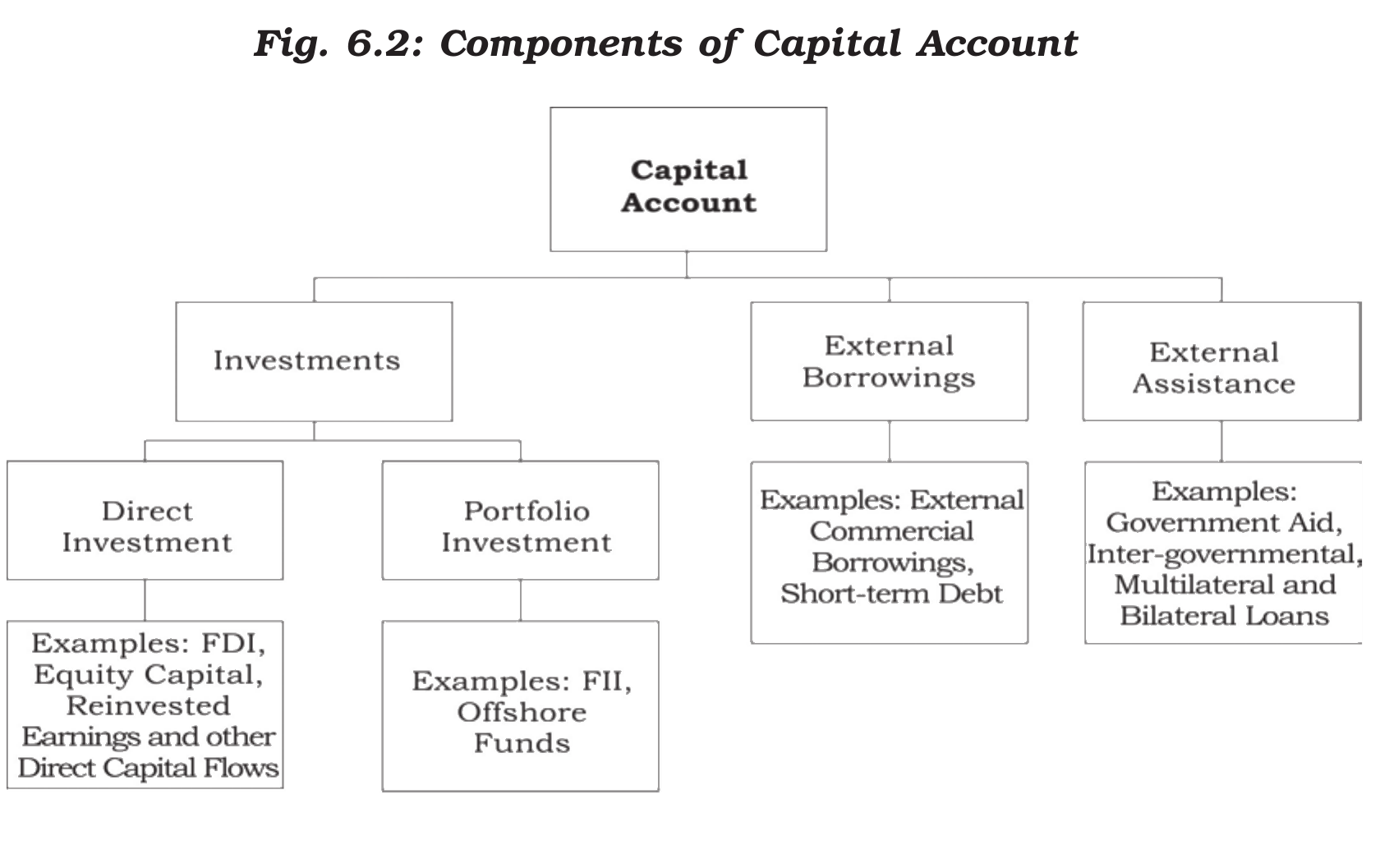
Option (2) Exports and imports of visible and invisible items and external borrowings. — Incorrect. Visible and invisible items do belong here. But external borrowings belong to the capital account, which records transactions in assets.
Option (3) Exports and imports of goods & services plus transfer payments. — Correct. Goods, services and transfers are the three parts of the current account.
Option (4) Short Term Debt. — Incorrect. Short-term debt is a kind of external borrowing, so it is an item of the capital account.
NCERT (2026-27): “6.1.1 Current Account Current Account is the record of trade in goods and services and transfer payments. Figure 6.1 illustrates the components of Current Account. Trade in goods includes exports and imports of goods. Trade in services includes factor income and non-factor income transactions. Transfer payments are the receipts which the residents of a country get for ‘free’, without having to provide any goods or services in return.… 6.1.2 Capital Account Capital Account records all international transactions of assets. An asset is any one of the forms in which wealth can be held, for example: money, stocks, bonds, Government debt, etc.… Fig. 6.2 classifies the items which are a part of capital account transactions. These items are Foreign Direct Investments (FDIs), Foreign Institutional Investments (FIIs), external borrowings and assistance.”
|