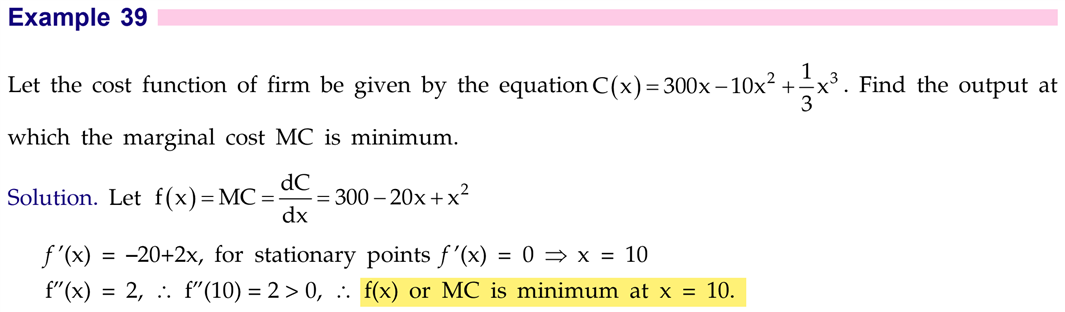
The cost function of a firm is given by \(C(x)=\displaystyle\frac{x^3}{3}-4x^2-65x+70\). The value of x that gives the minimum value of the marginal cost is:
Answer & explanation
Correct answer: option 2
The correct answer is Option (2) → 4 units
The marginal cost is the derivative of the cost function:
\(MC = C'(x) = x^2 - 8x - 65\)
To minimise MC, differentiate it once more:
\( \displaystyle \frac{d(MC)}{dx} = 2x - 8 = 0 \)
\(x = 4\)
\( \displaystyle \frac{d^2(MC)}{dx^2} = 2 \gt 0 \)
So MC is minimum at x = 4 units.
Why the other options are incorrect
Option (1) 2 units — Incorrect. At x = 2, d(MC)/dx = −4 ≠ 0, so MC is still falling.
Option (3) 5 units — Incorrect. At x = 5, d(MC)/dx = 2 ≠ 0, so MC is already rising.
Option (4) 13 units — Incorrect. This is where MC = (x − 13)(x + 5) = 0, the minimum of the total cost C(x), not of the marginal cost.
CBSE Applied Mathematics (Class XII):
Applied Problems