
CUETMOCK
  • Pricing
  • Mentors
Log inStart freeStart free mocks→

First test, then trust

Try a free CUET mock test.

Join 5,00,000+ students who rehearsed exam day on the exact NTA screen before sitting CUET. On the web and on Android.

Start free mocks →Get the Android app
CUETMOCK

India's #1 CUET Mock Test Platform. Original NCERT-based questions on the exact NTA exam screen — trusted by 5,00,000+ students since CUET 2022.

Get it onGoogle PlayScan to download the CUETMOCK app

Mock tests

  • CUET mock test series
  • Commerce mocks
  • Humanities (Arts) mocks
  • Science mocks
  • Languages & GAT mocks
  • Free practice questions
  • Pricing

Resources

  • CUET exam guide
  • CUET syllabus
  • Universities accepting CUET
  • Expert blogs
  • News & notifications
  • Webinars & counselling
  • CUET score calculator
  • How we estimate your rank
  • FAQs

Company

  • About us
  • Our leadership & team
  • Our toppers
  • Mentors
  • For schools
  • Contact us
  • Terms
  • Privacy
  • Refund policy

Talk to us

+91 7696 6630 56info@cuetmock.comWhatsApp us

Our other platforms

  • JEE Mock — For IIT-JEE aspirants
  • NEET Mock — For NEET aspirants

Newsletter

Exam updates, study material and offers — no spam.

© 2026 NYC Ventures Pvt. Ltd.

701-702, Royal Business Park, Zirakpur, Punjab - 140603

  • Terms of use
  • Privacy policy
  • Refund policy
  • Contact us

iCUETMOCK is an independent preparation platform, not affiliated with the National Testing Agency (NTA). Always check exam details on the official NTA website.

  • Home
  • Mock tests
  • CUET guide
  • Pricing
  • Log in
Home/Practice questions/Chemistry
ChemistryInorganic: D and F Block Elements

Which one of the following metals will not reduce H2O?

Which one of the following metals will not reduce H2O?

Answer & explanation+

Correct answer: option 3

The correct answer is Option (3) → Cu

  • A metal reduces water when it is oxidised and sets free hydrogen gas. This is judged from its standard electrode potential (E°).

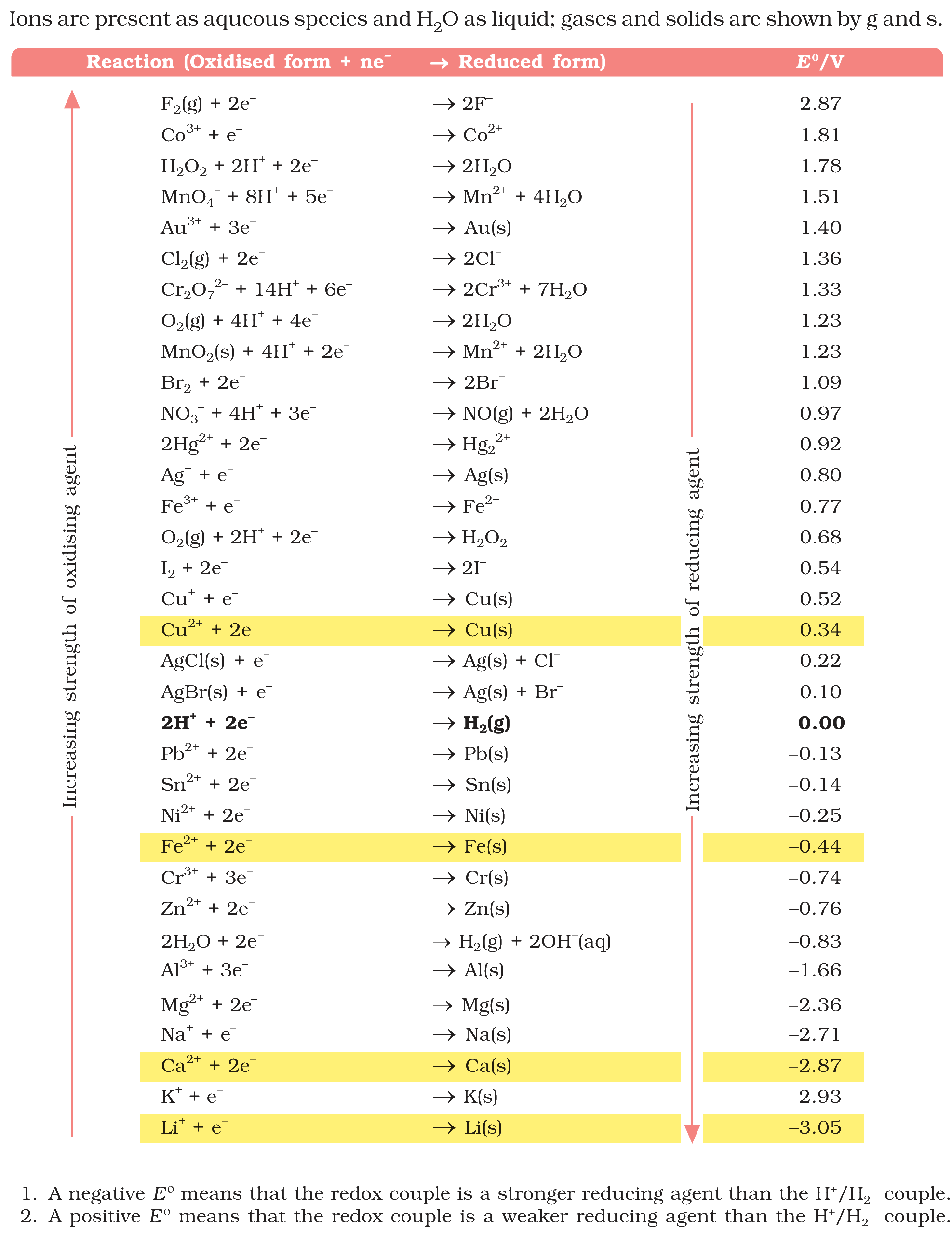
  • A metal with a negative E° is a stronger reducing agent than hydrogen; such a metal can set free \( \ce{H2} \) from water. A metal with a positive E° cannot set free \( \ce{H2} \) even from acids, so it cannot reduce water.

The values for the four metals are:

    \( \displaystyle E^{\circ}_{\ce{Li^+/Li}}=-3.05\,\mathrm{V} \quad\quad E^{\circ}_{\ce{Ca^2+/Ca}}=-2.87\,\mathrm{V} \)
    \( \displaystyle E^{\circ}_{\ce{Fe^2+/Fe}}=-0.44\,\mathrm{V} \quad\quad E^{\circ}_{\ce{Cu^2+/Cu}}=+0.34\,\mathrm{V} \)

Only copper has a positive E°, so it is the one metal here that does not reduce water.

Option (1) Li — Reduces water. Lithium has the most negative E° of all (−3.05 V), so it is the most powerful reducing agent in aqueous solution and sets free hydrogen from water:

    \( \displaystyle \ce{2Li + 2H2O -> 2LiOH + H2 ^} \)

Option (2) Fe — Reduces water. Iron has a negative E° (−0.44 V), so it is a stronger reducing agent than hydrogen, though a much weaker one than Li or Ca.

Option (3) Cu — Does not reduce water. Copper has a positive E° (+0.34 V): it is a weaker reducing agent than hydrogen, so it cannot liberate \( \ce{H2} \) from water or even from dilute acids.

Option (4) Ca — Reduces water. Calcium has a large negative E° (−2.87 V), so it is a strong reducing agent and sets free hydrogen from water:

    \( \displaystyle \ce{Ca + 2H2O -> Ca(OH)2 + H2 ^} \)

NCERT (2026-27 edition):
Table 2.1: Standard Electrode Potentials at 298 K – “… 2. A positive Eo means that the redox couple is a weaker reducing agent than the H+/H2 couple.”

Trends in the M2+/M Standard Electrode Potentials – “The unique behaviour of Cu, having a positive E°, accounts for its inability to liberate H2 from acids.”

Table 2.1: Standard Electrode Potentials at 298 K
Textbook table

Advertisement

Practise more on Inorganic: D and F Block Elements

Chapter-wise mocks on the real NTA exam screen, with solutions and your rank. Your first mocks are free.

Start free mocks →

Advertisement

Next questions

  1. 'वह लजा रही है।' - वाक्य में प्रयुक्त क्रिया का प्रकार पहचानिए :Hindi · व्याकरण - क्रिया
  2. Which of the following diseases is not caused by bacteria?General Aptitude Test · General Knowledge
  3. Which article of the constitution states that 'no one shall be deprived of his life or property except according to procedure established b…General Aptitude Test · General Knowledge
  4. Which of the following statement (s) is/are correct? Statement 1: Reforms post 1991 in India have benefitted agriculture to some extent onl…Economics · Indian Economic Development: Liberalisation, Privatisation and Globalisation - An Appraisal
  5. The first state of India to hold elections based on Universal Adult franchise:Political Science · Politics in India Since Independence: Challenges of nation Building
  6. Ragini Pathamsika of Raga Hindola belongs to which miniature painting.Fine Arts · The Deccani Schools of Painting
  7. The value of p for which the lines (1-x)/3=(7y-14)/2p=(z-3)/2 and (7-7x)/3p=(y-5)/1=(6-z)/5 are at right angles is:Maths. Section B1 · Three-dimensional Geometry
  8. Fill in the blanks with the correct pair of words arranged sequentially:The machinery in the old sugar mill ______ rusty, and more than one…English · Grammar: Subject-Verb Agreement
  9. Fill in the blank with the correct form of the verb:The two openers ______ for nearly three hours when the umpires finally stopped play bec…English · Grammar: Tenses
  10. Match List - I with List - II. List – I (Word) List – II (Antonym) (A) outflow (I) unpleasant (B) pleasant (II) opening (C) closing (III) u…English · Antonyms