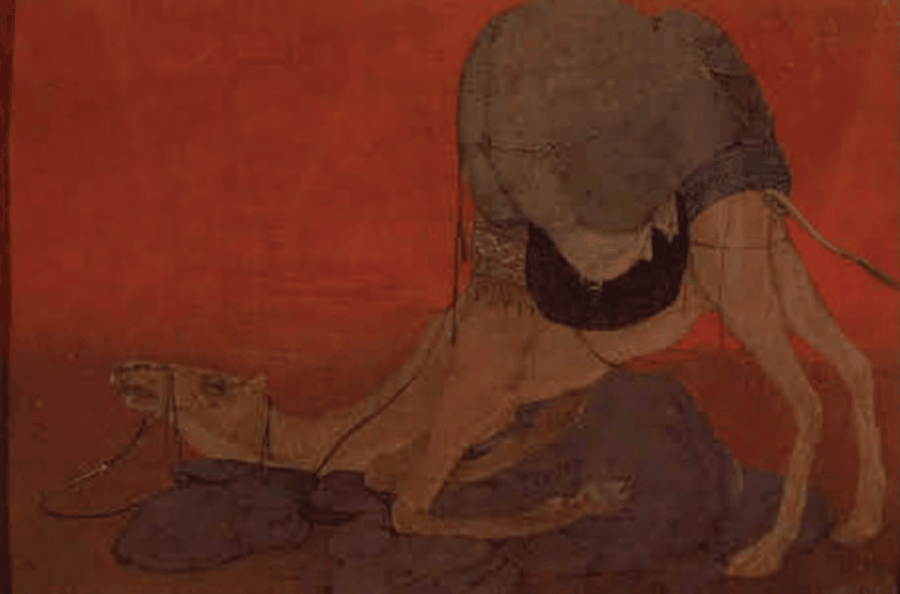
Abanindranath Tagore painted Journey’s End. Besides the influence of earlier painting traditions, what desire of the artist does this painting show?
Answer & explanation
Correct answer: option 4
The correct answer is Option (4) → To create an Indian style in painting
Option (1) To adopt the flat and colourful style of folk painting — Incorrect. This was Jamini Roy’s path, after he rejected his academic training in the colonial Art School.
Option (2) To create an abstract language of squares and circles — Incorrect. This abstract language belonged to the Bauhaus artists, such as Paul Klee and Kandinsky, shown in Calcutta in 1922.
Option (3) To create building interiors out of geometric patterns — Incorrect. Building interiors made of geometric patterns belong to Gaganendranath Tagore’s Cubist paintings.
Option (4) To create an Indian style in painting — Correct. Journey’s End shows the influence of Mughal and Pahari miniatures and Abanindranath’s desire to create an Indian style. He and Havell wanted to Indianise art education.
NCERT (2026-27): “Abanindranath Tagore and E. B. Havell The year 1896 was important in the Indian history of visual arts. E. B. Havell and Abanindranath Tagore saw a need to Indianise art education in the country. … Havell and Abanindranath Tagore designed a curriculum to include and encourage technique and themes in Indian art traditions. Abanindranath’s Journey’s End shows the influence of Mughal and Pahari miniatures, and his desire to create an Indian style in painting.”
|