
Observe the given diagram and answer the questions given below:
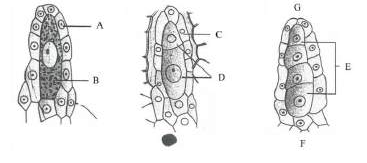
Which part of the ovule differentiates a large cell with dense cytoplasm and a prominent nucleus for megasporogenesis?
Answer & explanation
Correct answer: option 3
The correct answer is Option (3) → Centre of the nucellus
Note: The given answer is as per the official NTA Answer Key. However, the correct answer should be Option (1) Micropylar region of the nucellus, as explained below.
Why the answer given by NTA is incorrect
Option (1) Micropylar region of the nucellus — Correct as per NCERT. The large cell with dense cytoplasm and a prominent nucleus is the megaspore mother cell, and it is differentiated in the micropylar region of the nucellus.
Option (2) Chalazal region of the nucellus — Incorrect. The chalazal end is the opposite end of the ovule; the three antipodal cells come to lie there later, in the embryo sac.
Option (3) Centre of the nucellus — The answer given by NTA, but incorrect. NCERT places the megaspore mother cell in the micropylar region of the nucellus, not at its centre.
Option (4) Inner integument — Incorrect. The integuments are the protective layers round the nucellus; they do not form the megaspore mother cell.
NCERT Extract:
The Pistil, Megasporangium (ovule) and Embryo Sac – “Megasporogenesis : The process of formation of megaspores from the megaspore mother cell is called megasporogenesis. Ovules generally differentiate a single megaspore mother cell (MMC) in the micropylar region of the nucellus. It is a large cell containing dense cytoplasm and a prominent nucleus.”