
CUETMOCK
  • Pricing
  • Mentors
Log inStart freeStart free mocks→

First test, then trust

Try a free CUET mock test.

Join 5,00,000+ students who rehearsed exam day on the exact NTA screen before sitting CUET. On the web and on Android.

Start free mocks →Get the Android app
CUETMOCK

India's #1 CUET Mock Test Platform. Original NCERT-based questions on the exact NTA exam screen — trusted by 5,00,000+ students since CUET 2022.

Get it onGoogle PlayScan to download the CUETMOCK app

Mock tests

  • CUET mock test series
  • Commerce mocks
  • Humanities (Arts) mocks
  • Science mocks
  • Languages & GAT mocks
  • Free practice questions
  • Pricing

Resources

  • CUET exam guide
  • CUET syllabus
  • Universities accepting CUET
  • Expert blogs
  • News & notifications
  • Webinars & counselling
  • CUET score calculator
  • How we estimate your rank
  • FAQs

Company

  • About us
  • Our leadership & team
  • Our toppers
  • Mentors
  • For schools
  • Contact us
  • Terms
  • Privacy
  • Refund policy

Talk to us

+91 7696 6630 56info@cuetmock.comWhatsApp us

Our other platforms

  • JEE Mock — For IIT-JEE aspirants
  • NEET Mock — For NEET aspirants

Newsletter

Exam updates, study material and offers — no spam.

© 2026 NYC Ventures Pvt. Ltd.

701-702, Royal Business Park, Zirakpur, Punjab - 140603

  • Terms of use
  • Privacy policy
  • Refund policy
  • Contact us

iCUETMOCK is an independent preparation platform, not affiliated with the National Testing Agency (NTA). Always check exam details on the official NTA website.

  • Home
  • Mock tests
  • CUET guide
  • Pricing
  • Log in
Home/Practice questions/Physics
PhysicsAtoms

An alpha-particle of the experiment moves straight towards a gold nuc…

Read the following passage and answer the questions.

In 1911, H. Geiger and E. Marsden did a scattering experiment suggested by Rutherford. A radioactive source of \({}^{214}_{83}\mathrm{Bi}\) gave out alpha-particles of energy 5.5 MeV. The alpha-particles passed through lead bricks and then fell on a gold foil. The foil was only \(2.1\times10^{-7}\ \mathrm{m}\) thick. A detector made of a zinc sulphide screen and a microscope was placed near the foil. The detector could be turned around the foil. The whole apparatus was kept in a vacuum chamber. An alpha-particle carries a positive charge \(2e\). A gold nucleus carries a positive charge \(Ze\), with \(Z = 79\) for gold. The graph below shows the number of scattered alpha-particles detected at different scattering angles.
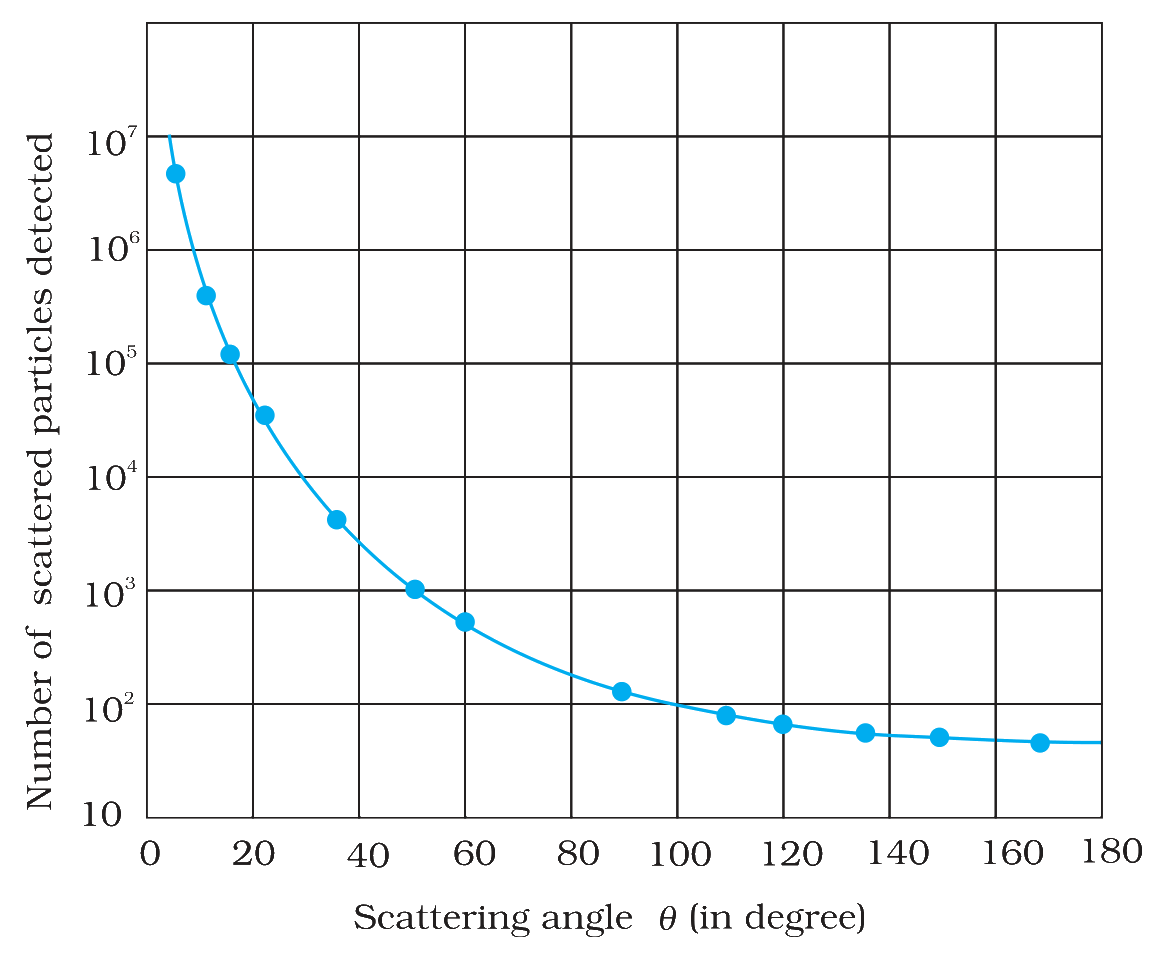
Graph of the number of scattered alpha-particles detected against the scattering angle

An alpha-particle of the experiment moves straight towards a gold nucleus. What is its kinetic energy when it is \(1.0\times10^{-13}\ \mathrm{m}\) from the centre of the nucleus? (Take \(1/4\pi\varepsilon_0=9\times10^{9}\ \mathrm{N\,m^{2}\,C^{-2}}\), \(e=1.6\times10^{-19}\ \mathrm{C}\) and \(1\ \mathrm{MeV}=1.6\times10^{-13}\ \mathrm{J}\).)

Answer & explanation+

Correct answer: option 2

The correct answer is Option (2) → 3.2 MeV

The alpha-particle and the gold nucleus repel each other. As the alpha-particle comes closer, some of its kinetic energy changes into electric potential energy. The total mechanical energy of the two stays the same.

Given:

    \( K_i=5.5\ \mathrm{MeV} \)

    \( r=1.0\times10^{-13}\ \mathrm{m} \)

    \( q_{\alpha}=2e \)

    \( Z=79 \)

Potential energy at this point:

    \( \begin{aligned} U &= \frac{1}{4\pi\varepsilon_0}\,\frac{(2e)(Ze)}{r} \\ &= \frac{9\times10^{9}\times2\times79\times(1.6\times10^{-19})^{2}}{1.0\times10^{-13}} \\ &= 3.64\times10^{-13}\ \mathrm{J} \end{aligned} \)

    \( \begin{aligned} U &= \frac{3.64\times10^{-13}}{1.6\times10^{-13}}\ \mathrm{MeV} \\ &\approx 2.3\ \mathrm{MeV} \end{aligned} \)

Kinetic energy at this point:

    \( \begin{aligned} K &= K_i-U \\ &= 5.5-2.3 \\ &= 3.2\ \mathrm{MeV} \end{aligned} \)

From the above, \( K \approx 3.2\ \mathrm{MeV} \). Hence, the alpha-particle is still moving at this point. It has not yet reached its distance of closest approach.

NCERT (2026-27):
Example 12.2 – “Solution The key idea here is that throughout the scattering process, the total mechanical energy of the system consisting of an α-particle and a gold nucleus is conserved. …”

“Let d be the centre-to-centre distance between the α-particle and the gold nucleus when the α-particle is at its stopping point. Then we can write the conservation of energy Ei = Ef as”

    \( \displaystyle K=\frac{1}{4\pi\varepsilon_0}\,\frac{(2e)(Ze)}{d}=\frac{2Ze^{2}}{4\pi\varepsilon_0 d} \)

Advertisement

Practise more on Atoms

Chapter-wise mocks on the real NTA exam screen, with solutions and your rank. Your first mocks are free.

Start free mocks →

Advertisement

Next questions

  1. An ideal capacitor of capacitance 0.2uF is charged to a potential difference of 10 V. The charging battery is then disconnected. The capaci…Physics · Alternating Current
  2. Primitive subsistence agriculture is not known by which name _______?Geography · Fundamentals of Human Geography: Primary Activities
  3. The value of ∫ (log (x / e))/((log x)^2) d x is :Maths. Section B1 · Indefinite Integration
  4. The minimum and maximum number of members required to form a private company as per Companies Act, 2013 are:Entrepreneurship · Entrepreneurial Planning
  5. A sum of money amounts to ₹28,224 in 2 years and to ₹29,635.20 in 3 years when invested on compound interest, compounded annually. What is…General Aptitude Test · Numerical Ability
  6. Arrange the following words as per the order in the dictionary: 1. Benevolent, 2. Beneficiary, 3. Belligerent, 4. Bemused, 5. BenefactorGeneral Aptitude Test · Verbal Reasoning
  7. When the surface of a metal is illuminated with the light of wavelength 400 nm, the KE of the ejected photoelectrons is 1.68 eV. Then the w…Physics · Dual Nature of Radiation and Matter
  8. Select the most appropriate meaning of the given idiom. Bed of rosesEnglish · Grammar: Idioms
  9. गद्यांश में प्रयुक्त 'मनोरथ' शब्द का सही संधि विच्छेद है -Hindi · Comprehension - (Narrative / Factual)
  10. Select the most appropriate meaning of the given idiom. To go to dogsEnglish · Grammar: Idioms