
CUETMOCK
  • Pricing
  • Mentors
Log inStart freeStart free mocks→

First test, then trust

Try a free CUET mock test.

Join 5,00,000+ students who rehearsed exam day on the exact NTA screen before sitting CUET. On the web and on Android.

Start free mocks →Get the Android app
CUETMOCK

India's #1 CUET Mock Test Platform. Original NCERT-based questions on the exact NTA exam screen — trusted by 5,00,000+ students since CUET 2022.

Get it onGoogle PlayScan to download the CUETMOCK app

Mock tests

  • CUET mock test series
  • Browse all papers
  • Commerce mocks
  • Humanities (Arts) mocks
  • Science mocks
  • Languages & GAT mocks
  • Free practice questions
  • Pricing

Resources

  • CUET exam guide
  • CUET syllabus
  • Universities accepting CUET
  • Expert blogs
  • News & notifications
  • Webinars & counselling
  • CUET score calculator
  • How we estimate your rank
  • FAQs

Company

  • About us
  • Our leadership & team
  • Our toppers
  • Mentors
  • For schools
  • Contact us
  • Terms
  • Privacy
  • Refund policy

Talk to us

+91 7696 6630 56info@cuetmock.comWhatsApp us

Our other platforms

  • JEE Mock — For IIT-JEE aspirants
  • NEET Mock — For NEET aspirants

Newsletter

Exam updates, study material and offers — no spam.

© 2026 NYC Ventures Pvt. Ltd.

701-702, Royal Business Park, Zirakpur, Punjab - 140603

  • Terms of use
  • Privacy policy
  • Refund policy
  • Contact us

iCUETMOCK is an independent preparation platform, not affiliated with the National Testing Agency (NTA). Always check exam details on the official NTA website.

  • Home
  • Mock tests
  • CUET guide
  • Pricing
  • Log in
Home/Practice questions/History
HistoryAncient India: Kinship, Caste and Class

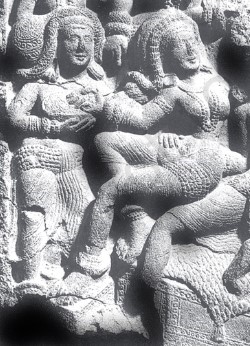
This sculpture of c. second century BCE shows a ruler and his wife of…

This sculpture of c. second century BCE shows a ruler and his wife of which dynasty?
Answer & explanation+

Correct answer: option 4

The correct answer is Option (4) → Satavahana

The sculpture is Fig. 3.3 of the chapter: a Satavahana ruler and his wife, from the wall of a cave given to Buddhist monks, dated to about the second century BCE.

NCERT (2026-27): “2.4 The gotra of women …
These names are available for powerful ruling lineages such as the Satavahanas who ruled over parts of western India and the Deccan (c. second century BCE-second century CE). Several of their inscriptions have been recovered, which allow historians to trace family ties, including marriages.”

“Fig. 3.3 A Satavahana ruler and his wife This is one of the rare sculptural depictions of a ruler from the wall of a cave donated to Buddhist monks. This sculpture dates to c. second century BCE.”

Advertisement

Practise more on Ancient India: Kinship, Caste and Class

Chapter-wise mocks on the real NTA exam screen, with solutions and your rank. Your first mocks are free.

Start free mocks →

Advertisement

Next questions

  1. In which year had the entire country (India) shifted to the Electronic Voting Machine for election purposes?Political Science · Politics in India Since Independence: Era of one Party Dominance
  2. In which year was Bombay given to the British Crown as a part of the dowry of Queen Catherine of Braganza?History · Modern India: Colonial cities
  3. Calculate the Proprietary Ratio from the following information: Share Capital = ₹5,00,000Non-Current Assets = ₹22,00,000Reserves and Surplu…Accountancy Part B · Accounting Ratios
  4. What is the main objective of the UN?Political Science · Contemporary World Politics: International Organisations
  5. The pie chart shows the percentage-wise break up of students in terms of specialisation in Engineering. Total number of students = 8000 Wha…General Aptitude Test · Quantitative Reasoning
  6. Which of the following statements are correct?(A) If a fixed rate is set below the market rate, there is an excess demand for dollars.(B) T…Economics · Macro Economics: Open Economy Macro Economics
  7. Saloni is the daughter of the only son of Kartik. Nirupama is the mother of Deepak. Yamini's only son, Ankit, is married to Nirupama. Karti…General Aptitude Test · Verbal Reasoning
  8. Under which of the following eras is this picture classified?Fine Arts · The Pahari Schools of Painting
  9. Select the option that expresses the given sentence in passive voice. The boy's cricket ball broke the neighbour's window.English · Grammar: Active Passive Voice
  10. Choose the word which is the opposite of "heed": (A) care(B) beware(C) notice(D) disregard Choose the correct answer from the options given…English · Comprehension - (Narrative / Factual)