
A student has drawn the following courses of rays through a glass prism. The one which represents the position of minimum deviation is:
Answer & explanation
Correct answer: option 3
The correct answer is Option (3)
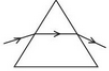
At the position of minimum deviation the path of the ray through the prism is symmetrical: the angle of incidence equals the angle of emergence, \( i = e \), and so the angles of refraction at the two faces are equal, \( r_1 = r_2 = A/2 \). As a result the ray inside the prism is parallel to the base.
Only the diagram in Option (3) shows this: the ray inside the prism is parallel to the base and the incident and emergent rays are inclined equally.
Why the other options are incorrect
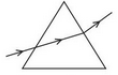
Option (1) — Incorrect. The ray inside the prism is not parallel to the base, so the path is not symmetrical.
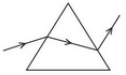
Option (2) — Incorrect. The ray inside the prism is not parallel to the base, and at the second face it is reflected instead of emerging.
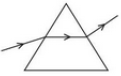
Option (4) — Incorrect. The ray inside the prism is parallel to the base, but the incident and emergent rays are not inclined equally to the faces, so \( i \ne e \). At minimum deviation the path must be symmetrical.
NCERT (2026-27):
Refraction Through a Prism – “… At the minimum deviation Dm, the refracted ray inside the prism becomes parallel to its base. We have \( \delta = D_m \), \( i = e \) which implies \( r_1 = r_2 \).”