Match List-I with List-II:
| List-I Names | List-II Associations | ||
| (A) | Piyadassi | (I) | Script |
| (B) | Kalinga | (II) | Reporter |
| (C) | Kharosthi | (III) | Asoka |
| (D) | Pativedaka | (IV) | Coastal Orissa |
Choose the correct answer from the options given below:
Answer & explanation
Correct answer: option 4
The correct answer is Option (4) → (A)-(III), (B)-(IV), (C)-(I), (D)-(II)
(A) Piyadassi — this matches (III) Asoka. Most of the inscriptions deciphered by James Prinsep mentioned a king called Piyadassi, “pleasant to behold”; a few of them also called the king Asoka.
(B) Kalinga — this matches (IV) Coastal Orissa. Asoka conquered Kalinga, present-day coastal Orissa.
(C) Kharosthi — this matches (I) Script. Brahmi and Kharosthi were the two scripts used in the earliest inscriptions and coins; Prinsep deciphered both in the 1830s.
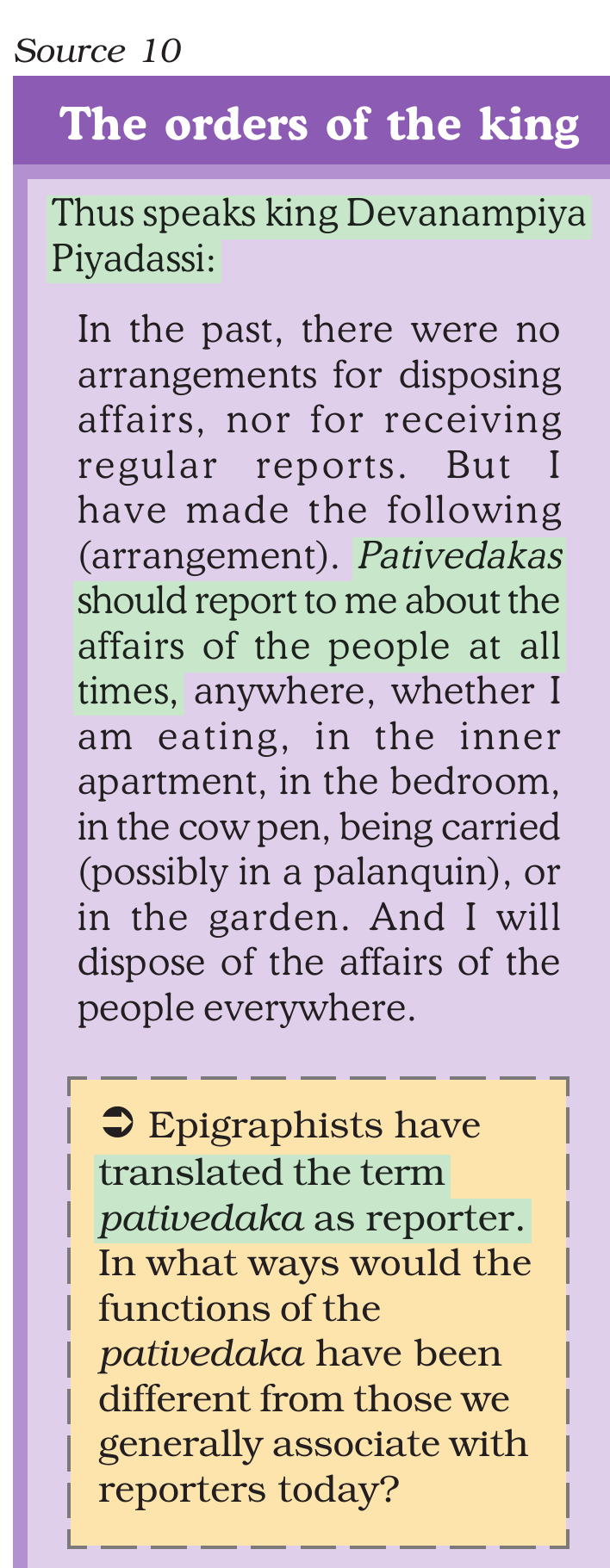
(D) Pativedaka — this matches (II) Reporter. Asoka ordered that the pativedakas should report to him about the affairs of the people at all times; epigraphists translate the term as reporter.
NCERT (2026-27): “1. Prinsep and Piyadassi … Some of the most momentous developments in Indian epigraphy took place in the 1830s. This was when James Prinsep, an officer in the mint of the East India Company, deciphered Brahmi and Kharosthi, two scripts used in the earliest inscriptions and coins. He found that most of these mentioned a king referred to as Piyadassi – meaning ‘pleasant to behold’; there were a few inscriptions which also referred to the king as Asoka, one of the most famous rulers known from Buddhist texts.… 3. An Early Empire … The growth of Magadha culminated in the emergence of the Mauryan Empire. Chandragupta Maurya, who founded the empire (c. 321 BCE), extended control as far northwest as Afghanistan and Baluchistan, and his grandson Asoka, arguably the most famous ruler of early India, conquered Kalinga (present-day coastal Orissa).…”
|