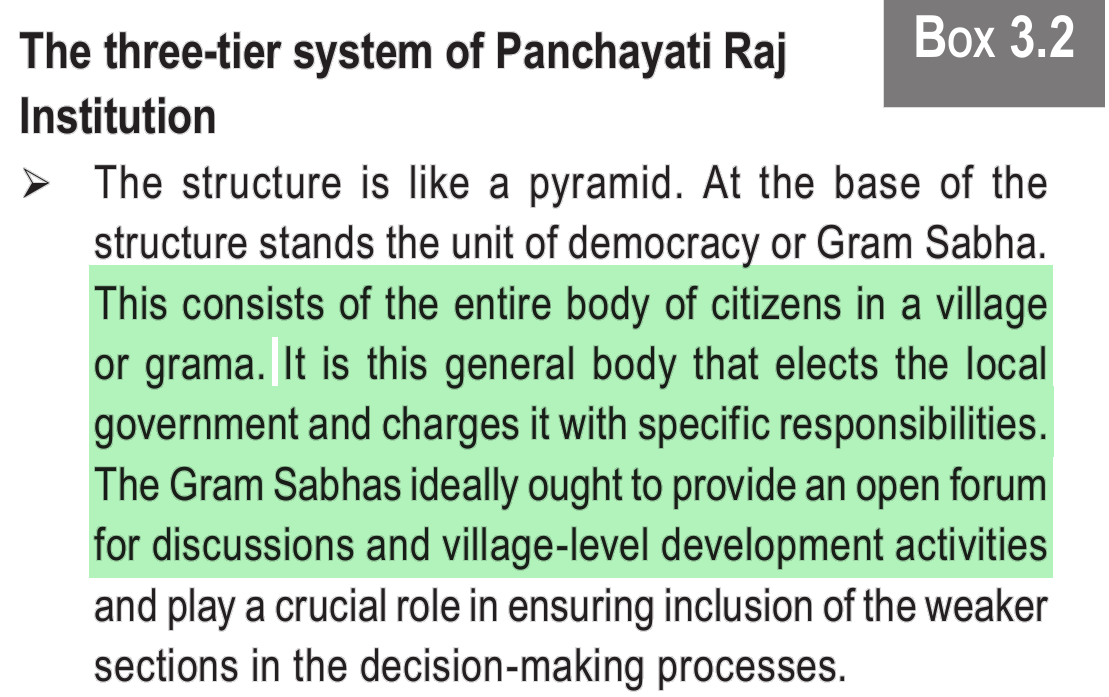
Which of the following are true about Gram Sabha in Panchayati Raj?
(A) The Gram Sabha collects central taxes from the village.
(B) The Gram Sabha consists of the entire body of citizens in a village.
(C) The Gram Sabha is the general body that elects the local government.
(D) The Gram Sabha participates in village-level development activities.
Choose the correct answer from the options given below:
Answer & explanation
Correct answer: option 4
The correct answer is Option (4) → (B), (C) and (D) only
(A) The Gram Sabha collects central taxes from the village. Incorrect. The Gram Sabha is the general body of the village, a forum where citizens meet and discuss. It has no role in collecting central taxes, which are levied by the Union government. The power to levy and collect taxes, duties, tolls and fees at the local level was given to the elected Panchayats, not to the Gram Sabha.
(B) The Gram Sabha consists of the entire body of citizens in a village. Correct. At the base of the Panchayati Raj pyramid stands the unit of democracy, the Gram Sabha, which consists of the entire body of citizens in a village or grama.
(C) The Gram Sabha is the general body that elects the local government. Correct. It is this general body that elects the local government and charges it with specific responsibilities.
(D) The Gram Sabha participates in village-level development activities. Correct. The Gram Sabhas ideally ought to provide an open forum for discussions and village-level development activities, and to ensure that the weaker sections are included in decision-making.
NCERT: Social Change and Development in India — Chapter 3: The Constitution and Social Change (2025-26)
|