
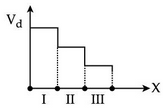
Figure shows drift speed \( V_d \) of conduction electrons in a copper wire versus position (X) for the three sections. Then,
(A) Radius of III > Radius of II > Radius of I
(B) Electric Field in III > Electric Field in II > Electric Field in I
(C) Radius of wire is same in all sections
(D) Conductivity is same in all sections
Choose the correct answer from the options given below :
Answer & explanation
Correct answer: option 3
The correct answer is Option (3) → (A) and (D) only
The three sections are parts of one wire, so the same current \( I \) flows through each. The current is related to the drift speed by
\( \displaystyle I = n e A V_d \;\Rightarrow\; V_d = \frac{I}{n e A} \)
The wire is copper throughout, so \( n \) is the same. Hence \( V_d \propto 1/A \). The figure shows \( V_d \) falling from I to III, so the area (and the radius) rises from I to III.
The drift speed is also \( V_d = \mu E \), where \( \mu \) is the mobility, the same for the same material, so \( E \propto V_d \).
(A) Radius of III > Radius of II > Radius of I — Correct. The smallest drift speed (section III) needs the largest area.
(B) Electric Field in III > Electric Field in II > Electric Field in I — Incorrect. Since \( E \propto V_d \), the field is largest in I and smallest in III, the reverse order.
(C) Radius of wire is same in all sections — Incorrect. With the same current, equal radii would give equal drift speeds, but the drift speeds differ.
(D) Conductivity is same in all sections — Correct. Conductivity is a property of the material, and all three sections are copper.