Which one of the following formula is correct for the Marginal Revenue Product of the labor (MRPL)?
Answer & explanation
Correct answer: option 2
The correct answer is Option (2) → MRPL = MR × MPL
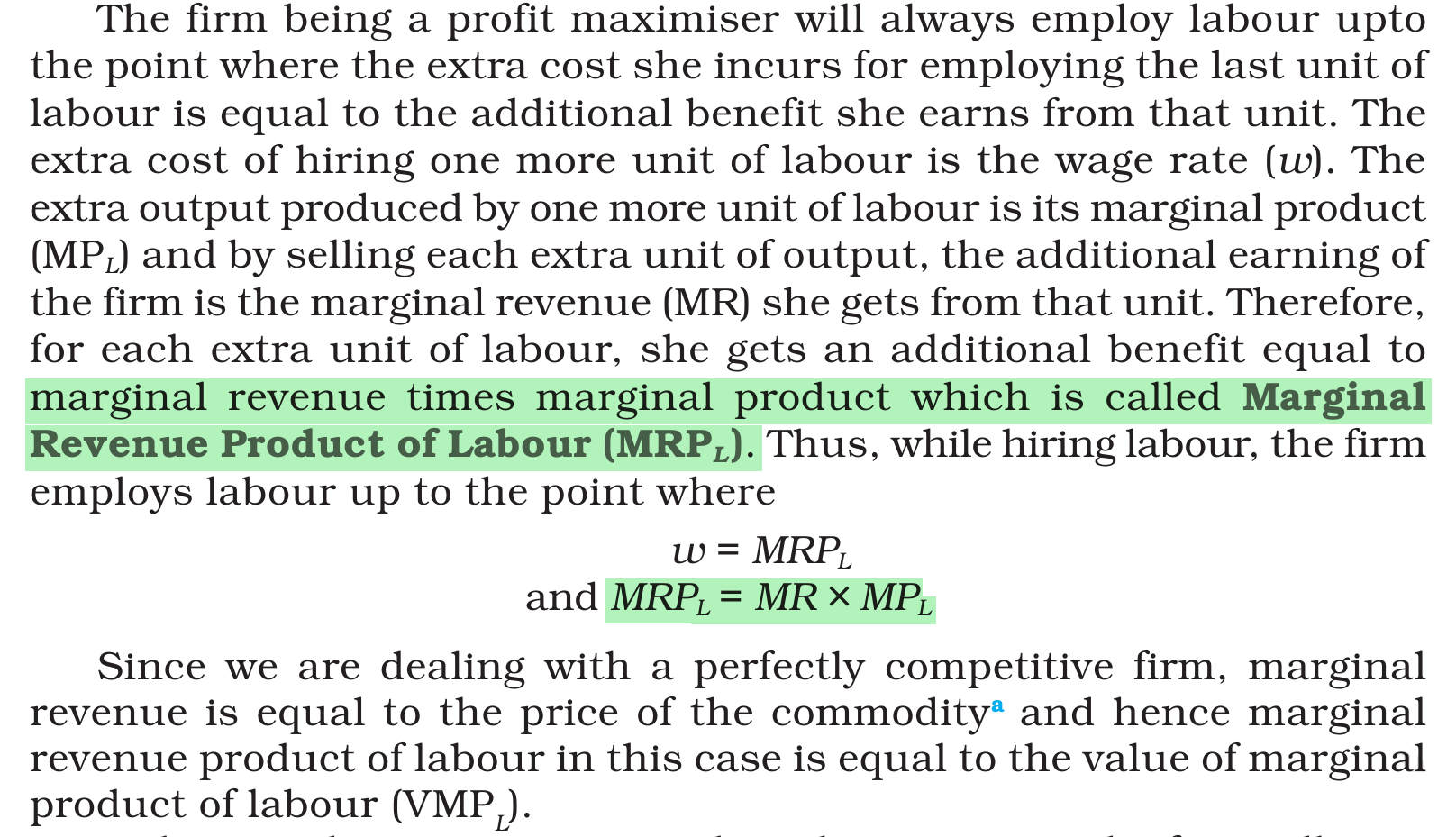
A firm hires one more worker only if the worker brings in at least as much as the worker costs. The extra worker adds a marginal product (MPL) to output, and each extra unit of that output sold brings in the marginal revenue (MR). The extra revenue from one more unit of labour is therefore marginal revenue times marginal product, the marginal revenue product of labour:
MRPL = MR × MPL
The firm employs labour up to the point where the wage equals MRPL. For a perfectly competitive firm MR equals the price, so MRPL is then the value of the marginal product of labour, P × MPL.
Why the other options are incorrect
Option (1) MRPL = AR × MPL — Incorrect. Average revenue times marginal product is the value of the marginal product; it equals MRPL only under perfect competition, where AR = MR, so it is not the general formula.
Option (3) MRPL = MR × MRL — Incorrect. The formula multiplies marginal revenue by the marginal product of labour, the extra output from one more worker; there is no ‘marginal revenue of labour’ in it.
Option (4) MRPL = MP × MRL — Incorrect. Here the subscript has moved from the marginal product to the marginal revenue. It is the marginal product that belongs to labour, while the marginal revenue belongs to the output sold.
NCERT: Introductory Microeconomics — Chapter 5: Market Equilibrium (2025-26)
|