| Input | Output | Marginal productivity of factor |
| 10 L1 | 20 Q1 | MPL = ? |
| 12 L2 | 25 Q2 | |
| 8 K3 | 16 Q3 | MPK = ? |
| 10 K4 | 20 Q4 |
Where labour input L1 and L2 are related to output Q1 and Q2 respectively
Capital input K3 and K4 are related to output Q3 and Q4 respectively
Find the values of MPL and MPK.
Answer & explanation
Correct answer: option 3
The correct answer is Option (3) → MPL = 2.5, MPK = 2
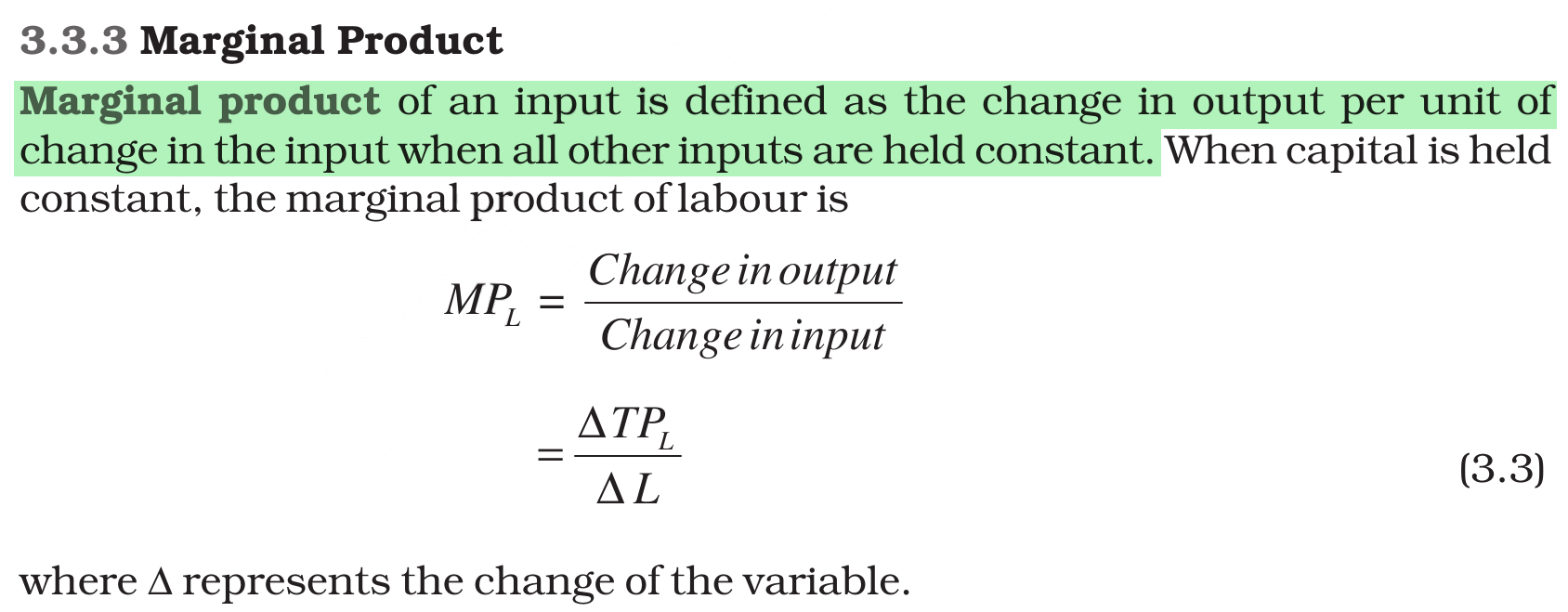
If a firm takes on three more workers and output rises by 6 units, each extra worker has added 2 units. That is the marginal product of an input: the change in output per unit change in that input, all other inputs held constant.
Given:
Labour: L1 = 10 gives Q1 = 20; L2 = 12 gives Q2 = 25
Capital: K3 = 8 gives Q3 = 16; K4 = 10 gives Q4 = 20
MP = Change in output ÷ Change in input
For labour:
Change in output = 25 − 20 = 5
Change in labour = 12 − 10 = 2
MPL = 5 ÷ 2 = 2.5
For capital:
Change in output = 20 − 16 = 4
Change in capital = 10 − 8 = 2
MPK = 4 ÷ 2 = 2
MPL = 2.5 and MPK = 2, as in Option (3)
Option (1) has the same two numbers the other way round, so the two inputs must be kept apart: labour goes with Q1 and Q2, capital with Q3 and Q4.
NCERT: Introductory Microeconomics — Chapter 3: Production and Costs (2025-26)
|