Which of the following sets of oxometal ions of the 3d series, shows the transition metals ion oxidation number equal to its group number?
Answer & explanation
Correct answer: option 1
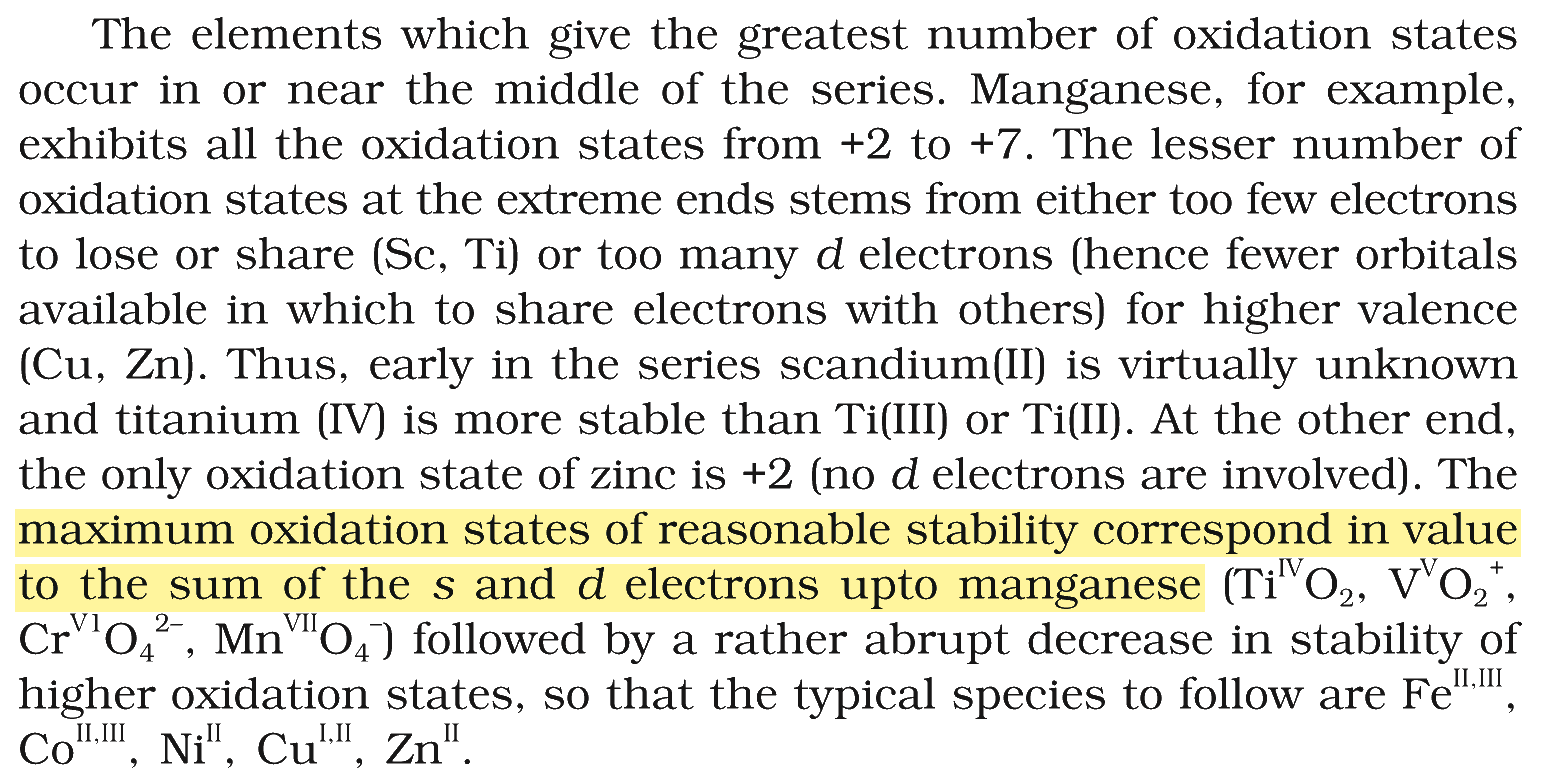
The correct answer is Option (1) → [CrO4]2−, [MnO4]−, [VO2]+
For the early 3d metals, the highest oxidation state equals the group number, because all the 4s and 3d electrons are used in bonding: Sc +3 (group 3), Ti +4 (group 4), V +5 (group 5), Cr +6 (group 6), Mn +7 (group 7). These high states are stabilised in oxo ions, because oxygen can form multiple bonds with the metal.
To find the oxidation number x of the metal in an oxo ion, take oxygen as −2 and set the total equal to the charge on the ion:
\( \displaystyle [\mathrm{CrO_4}]^{2-}:\quad x+4(-2)=-2,\quad x=+6 \)
\( \displaystyle [\mathrm{MnO_4}]^{-}:\quad x+4(-2)=-1,\quad x=+7 \)
\( \displaystyle [\mathrm{VO_2}]^{+}:\quad x+2(-2)=+1,\quad x=+5 \)
Cr (group 6) is +6, Mn (group 7) is +7 and V (group 5) is +5. So in every ion of Option (1), the oxidation number equals the group number.
Why the other options are incorrect
Option (2) [VO4]3−, [Cr2O7]2−, [VO]2+ — Incorrect. V is +5 in \( \ce{[VO4]^{3-}} \) and Cr is +6 in \( \ce{[Cr2O7]^{2-}} \), but V is only +4 in the vanadyl ion \( \ce{[VO]^{2+}} \).
Option (3) [VO]2+, [CrO4]2−, [MnO4]2− — Incorrect. V is +4 in \( \ce{[VO]^{2+}} \), and Mn is only +6 in the manganate ion \( \ce{[MnO4]^{2-}} \), not +7.
Option (4) [VO3]−, [VO]2+, [TiO]2+ — Incorrect. V is +5 in \( \ce{[VO3]^{-}} \) and Ti is +4 in \( \ce{[TiO]^{2+}} \), but V is +4 in \( \ce{[VO]^{2+}} \).
NCERT (2026-27 edition):
Oxidation States – …