Match List I with List II
| LIST-I (Agrarian Concepts) | LIST-II (Characteristics) | ||
| (A) | Farmers suicide | (I) | Sociologist |
| (B) | National Urban Mission | (II) | Govt of India |
| (C) | Green Revolution | (III) | Agricultural modernisation |
| (D) | Jan Breman | (IV) | Agrarian Distress |
Choose the correct answer from the options given below:
Answer & explanation
Correct answer: option 1
The correct answer is Option (1) → A-IV, B-II, C-III, D-I
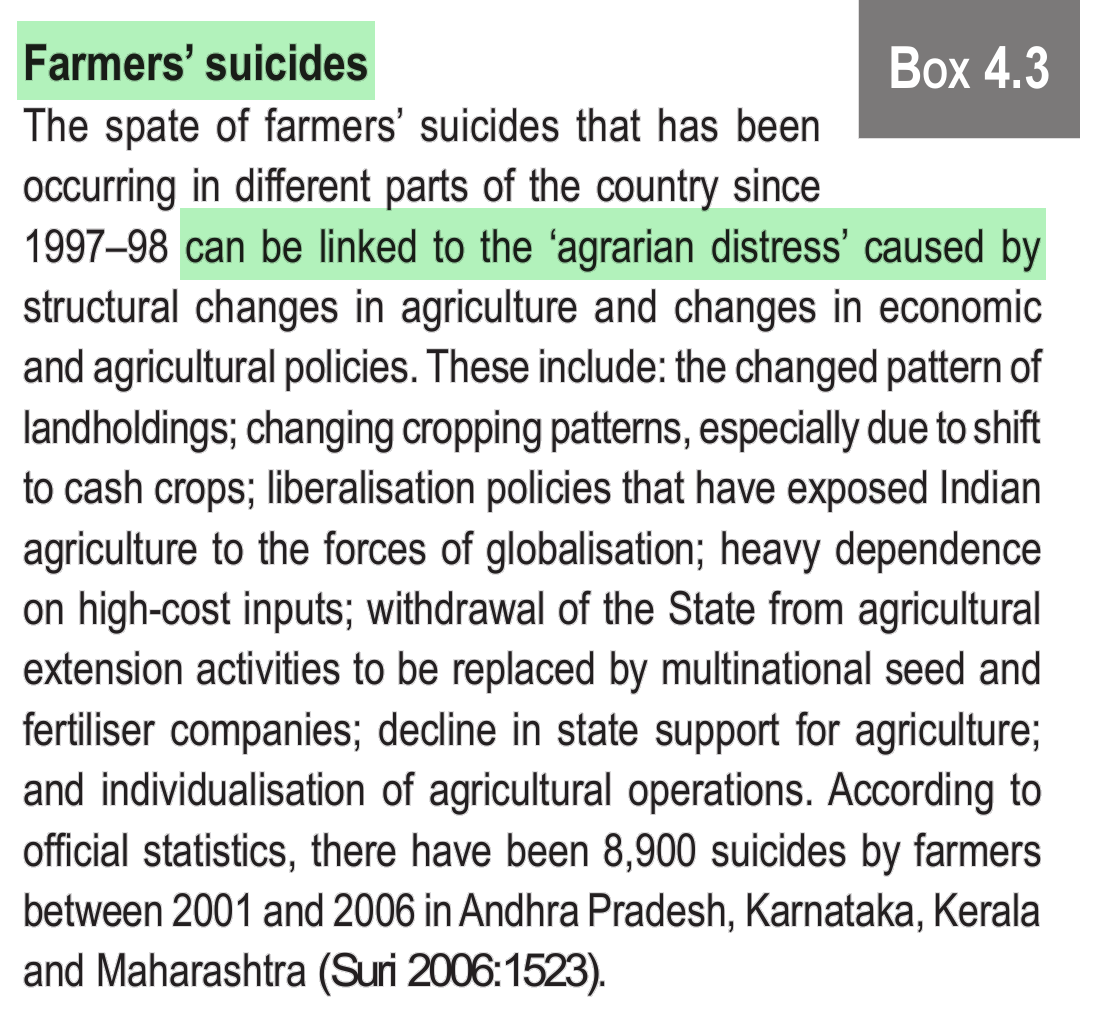
(A) Farmers suicide — this matches (IV) Agrarian Distress. The spate of farmers’ suicides since 1997–98 can be linked to the ‘agrarian distress’ caused by structural changes in agriculture and in economic and agricultural policies.
(B) National Urban Mission — this matches (II) Govt of India. It is one of the schemes of the Government of India, with the Pradhan Mantri Fasal Bima Yojana and the Kisan Credit Card, that may provide help to farmers.
(C) Green Revolution — this matches (III) Agricultural modernisation. The Green Revolution was a government programme of agricultural modernisation, based on high-yielding variety seeds with pesticides, fertilisers and other inputs.
(D) Jan Breman — this matches (I) Sociologist. The sociologist Jan Breman described the change in agrarian labour relations as a shift from ‘patronage to exploitation’, and termed migrant workers ‘footloose labour’.
NCERT (2025-26): “4.6 Globalisation, Liberalisation, and Rural Society … Suicides of farmers is basically associated with debt, as well as, natural disasters, resulting in the failure of agricutural produce. Pradhan Mantri Fasal Bima Yojana, Gram Uday se Bharat Uday Abhiyan, National Urban Mission, National Mission for Sustainable Agriculture and Kisan Credit Card, etc., are some of the schemes of the Government of India, which may provide unified help to farmers all over the country. These schemes are also helpful in providing quality life to rural India.” “4.3 The Green Revolution and its Social Consequences … In contrast the Green Revolution of the 1960s and 1970s brought about significant changes in the areas where it took place. The Green Revolution, as you know, was a government programme of agricultural modernisation. It was largely funded by international agencies that was based on providing high-yielding variety(HYV) or hybrid seeds…” “4.4 Transformations in Rural Society … The change in the nature of the relationship between landlords (who usually belonged to the dominant castes) and agricultural workers (usually low caste), was described by the sociologist Jan Breman as a shift from ‘patronage to exploitation’ (Breman, 1974).…”
Box 4.3 (NCERT 2025-26) |