
CUETMOCK
  • Pricing
  • Mentors
Log inStart freeStart free mocks→

First test, then trust

Try a free CUET mock test.

Join 5,00,000+ students who rehearsed exam day on the exact NTA screen before sitting CUET. On the web and on Android.

Start free mocks →Get the Android app
CUETMOCK

India's #1 CUET Mock Test Platform. Original NCERT-based questions on the exact NTA exam screen — trusted by 5,00,000+ students since CUET 2022.

Get it onGoogle PlayScan to download the CUETMOCK app

Mock tests

  • CUET mock test series
  • Commerce mocks
  • Humanities (Arts) mocks
  • Science mocks
  • Languages & GAT mocks
  • Free practice questions
  • Pricing

Resources

  • CUET exam guide
  • CUET syllabus
  • Universities accepting CUET
  • Expert blogs
  • News & notifications
  • Webinars & counselling
  • CUET score calculator
  • How we estimate your rank
  • FAQs

Company

  • About us
  • Our leadership & team
  • Our toppers
  • Mentors
  • For schools
  • Contact us
  • Terms
  • Privacy
  • Refund policy

Talk to us

+91 7696 6630 56info@cuetmock.comWhatsApp us

Our other platforms

  • JEE Mock — For IIT-JEE aspirants
  • NEET Mock — For NEET aspirants

Newsletter

Exam updates, study material and offers — no spam.

© 2026 NYC Ventures Pvt. Ltd.

701-702, Royal Business Park, Zirakpur, Punjab - 140603

  • Terms of use
  • Privacy policy
  • Refund policy
  • Contact us

iCUETMOCK is an independent preparation platform, not affiliated with the National Testing Agency (NTA). Always check exam details on the official NTA website.

  • Home
  • Mock tests
  • CUET guide
  • Pricing
  • Log in
Home/Practice questions/Applied Maths. Section B2
Applied Maths. Section B2Inferential Statistics

Which of the following is not correct about the Central Limit Theorem?

Which of the following is not correct about the Central Limit Theorem?

Answer & explanation+

Correct answer: option 4

The correct answer is Option (4) → The sampling distribution of the sample mean approaches a Poisson distribution as the sample size gets larger.

The Central Limit Theorem says that, for a large sample, the sampling distribution of the sample mean is approximately normal, whatever the shape of the population.

Options (1), (2) and (3) are true. The normal curve is the bell-shaped curve; a sample of 30 or more is the usual rule for “large”; and the standard error \(\frac{\sigma}{\sqrt{n}}\) falls as n grows, so estimates of the population become more accurate.

Option (4) is not correct: the sampling distribution approaches a normal distribution, not a Poisson distribution.

CBSE Applied Mathematics (Class XII):
Central Limit Theorem
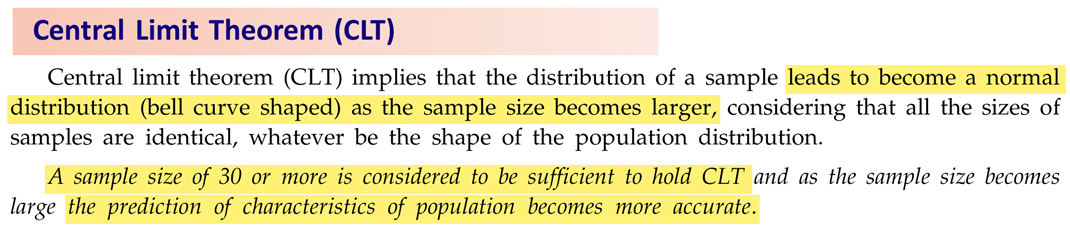
CBSE extract

Advertisement

Practise more on Inferential Statistics

Chapter-wise mocks on the real NTA exam screen, with solutions and your rank. Your first mocks are free.

Start free mocks →

Advertisement

Next questions

  1. If price of a commodity rises from Rs. 10 to Rs. 15, its supply increases by 20%. Calculate the price elasticity of supply for this commodi…Economics · Micro Economics: Theory of Firms under Perfect Competition
  2. The value of a in order that f(x)=√3sin x-cos x-2ax+b decreases for all real values of x, is given by:Maths. Section B1 · Applications of Derivatives
  3. Out of Milk, butter, ice cream and lemonade. Identify the one that is not a colloid.Chemistry · Physical: Surface Chemistry
  4. Select the most appropriate option to fill in the blank. Most natural diamonds have some type of______.English · Fill Blanks
  5. Identify the correct sequence involved in the formation of female gametophyte in angiosperms?(A) 2-nucleated embryo sac(B) Functional megas…Biology · Sexual Reproduction in Flowering Plants
  6. Which of the following definition is correct answer of the production possibility set of the economy ?Economics · Micro Economics: Introduction
  7. Which of the followings is NOT a monosaccharide?Chemistry · Organic: Biomolecules
  8. गद्यांश के अनुसार 'परागण' किसे कहते हैं?Hindi · अपठित गद्यांश (Comprehension - Prose)
  9. What is the unit of rate constant for a zero order reaction?Chemistry · Physical: Chemical Kinetics
  10. Find ∫ (x sin^-1 x)/(√(1-x^2)) dxMaths. Section B1 · Indefinite Integration