Adsorption is the phenomenon of attracting and retaining the molecules of a substance on the surface of a solid resulting into a higher concentration on the surface than in the bulk. The substance adsorbed is known as adsorbate and the substance on which adsorption takes place is called adsorbent. In physisorption adsorbate is held to the adsorbent by weak van der Waals forces and in chemisorption by strong chemical bond.
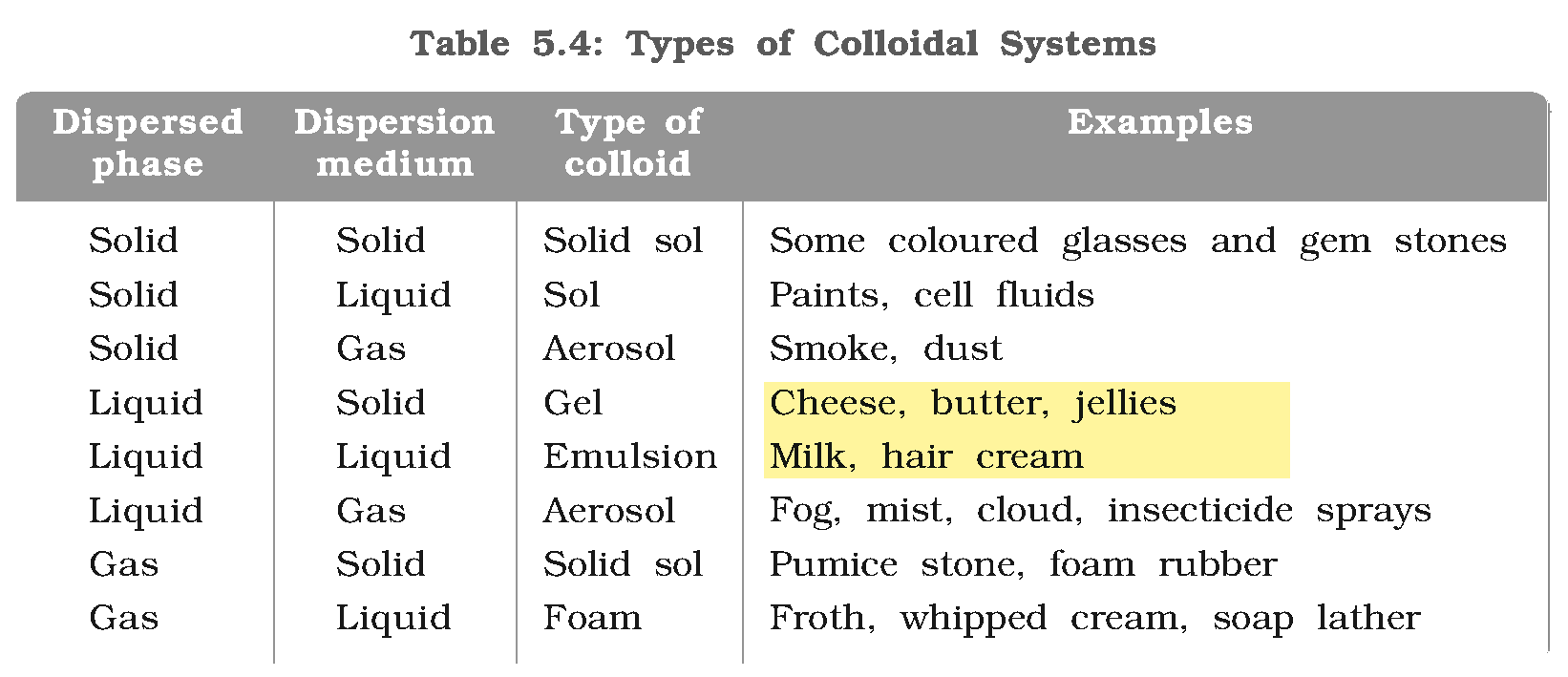
Out of Milk, butter, ice cream and lemonade. Identify the one that is not a colloid.
Answer & explanation
Correct answer: option 2
The correct answer is Option (2) → Lemonade
Note 1: NTA dropped this question in the official Answer Key. However, to provide additional question practice to the students, the question has been slightly modified so that the question has one clear answer.
Mixtures are classed by the size of the dispersed particles: in a true solution they are smaller than about 1 nm (single molecules or ions), in a colloid they are between 1 nm and 1000 nm, and in a suspension they are larger.
Milk — an emulsion of liquid fat dispersed in water: a colloid.
Butter — water dispersed in fat (a gel): a colloid.
Ice cream — air and fat dispersed in a frozen aqueous phase: a colloid.
Lemonade — sugar, citric acid and salts dissolved in water as molecules and ions: a true solution.
Note 2: This question is from the pre-rationalised NCERT book (2022-23). The topic is not there in the latest NCERT book (2026-27), and it is also out of the CUET 2026 syllabus.
NCERT (Pre-rationalised edition, 2022-23):
Classification of Colloids – …