
Read the passage carefully and answer.
The molar conductivity of a solution at any given concentration is the conductance of the volume of solution containing one mole of electrolyte kept between two platinum electrodes with unit area of cross-section and at a distance of unit length. Both conductivity and molar conductivity change with the concentration of the electrolyte. Kohlrausch examined $Ʌ°_m$ values for a number of strong electrolytes and observed certain regularities. He noted that the difference in $Ʌ°_m$ of the electrolytes NaX and KX for any X is nearly constant. On the basis of the above observations, he enunciated the Kohlrausch law of independent migration of ions.
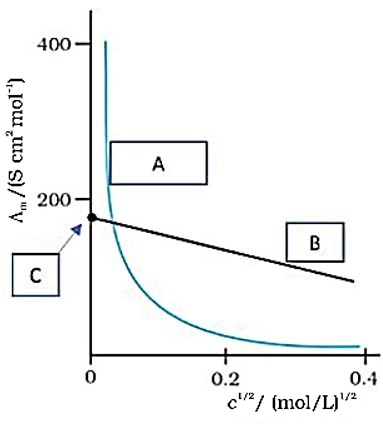
A $0.001\, mol\, L^{-1}$ solution of acetic acid shows conductivity of $5.02 × 10^{-5}\, S\, cm^{-1}$. If $Ʌ°_m$ for acetic acid is $390\, cm^2\, mol^{-1}$, then the degree of dissociation is
Answer & explanation
Correct answer: option 1
The correct answer is Option (1) → 0.12
We can calculate the degree of dissociation (α) using:
$\alpha = \frac{\Lambda_m}{\Lambda_m^\circ}$
Where:
$\Lambda_m$ = molar conductivity at given concentration
$\Lambda_m^\circ$ = molar conductivity at infinite dilution
Step 1: Calculate $\Lambda_m$
$\Lambda_m = \frac{\kappa \times 1000}{c}$
Given:
$\kappa = 5.02\times10^{-5}\ \mathrm{S\,cm^{-1}}$,
$c = 0.001\ \mathrm{mol\,L^{-1}}$
$\Lambda_m = \frac{5.02\times10^{-5} \times 1000}{0.001} = \frac{0.0502}{0.001} = 50.2\ \mathrm{S\,cm^2\,mol^{-1}}$
Step 2: Calculate α
$\alpha = \frac{\Lambda_m}{\Lambda_m^\circ} = \frac{50.2}{390} \approx 0.1287 \approx 0.12$