Choose the correct sequence
A. Factor payments
B. Goods and services produced and sold in the market
C. Supply of factors of production by the households
D. Spending on goods and services
Choose the correct answer from the options given below:
Answer & explanation
Correct answer: option 2
The correct answer is Option (2) → C, B, A, D
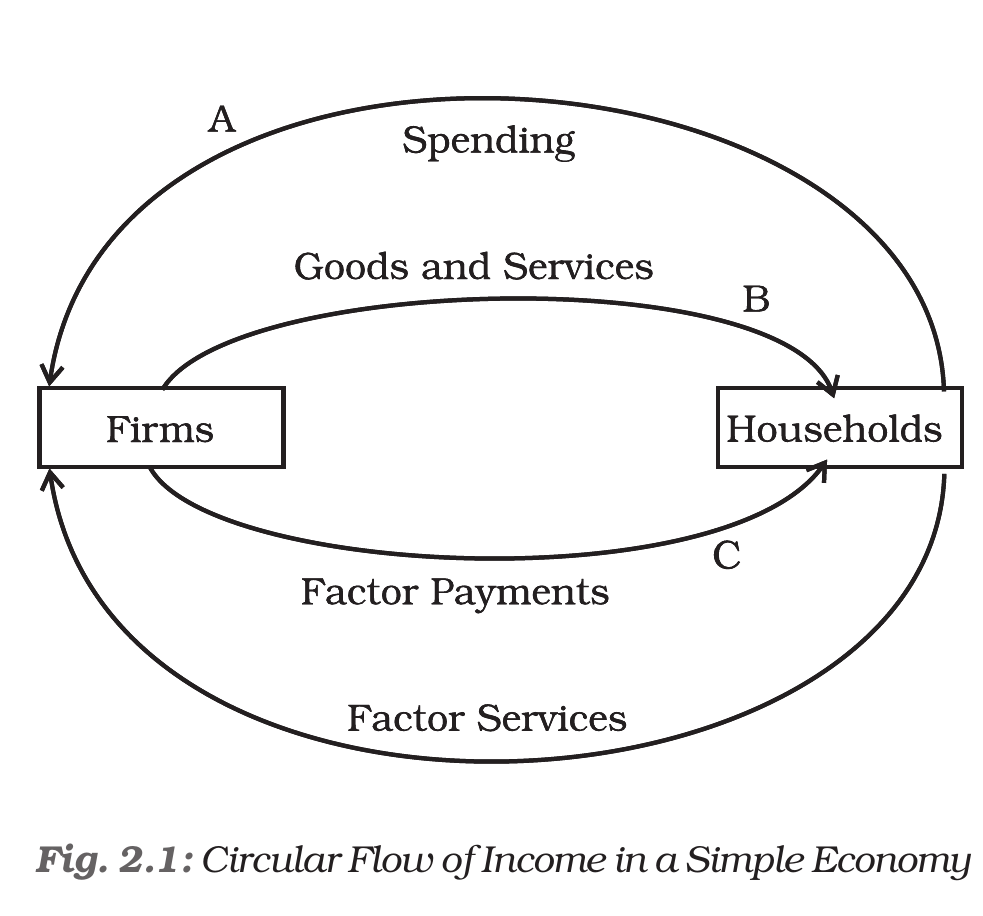
In a simple economy, income moves in a circle between households and firms.
(C) Supply of factors of production by the households — Households own land, labour, capital and entrepreneurship, and supply them to firms.
(B) Goods and services produced and sold in the market — With these factors, firms produce goods and services and sell them.
(A) Factor payments — Firms pay rent, wages, interest and profits to the households for the factors they used.
(D) Spending on goods and services — Households spend this income on the firms’ goods. So the money goes back to the firms and the circle starts again.
NCERT (2026-27): “2.2 Circular Flow of Income and Methods of Calculating National Income …In the next period the firms will once again produce goods and services and pay remunerations to the factors of production. These remunerations will once again be used to buy the goods and services. Hence year after year we can imagine the aggregate income of the economy going through the two sectors, firms and households, in a circular way. This is represented in Fig. 2.1.… In Fig. 2.1, the uppermost arrow, going from the households to the firms, represents the spending the households undertake to buy goods and services produced by the firms. The second arrow going from the firms to the households is the counterpart of the arrow above.… The two arrows at the bottom of the diagram similarly represent the factors of production market. The lower most arrow going from the households to the firms symbolises the services that the households are rendering to the firms. Using these services the firms are manufacturing the output. The arrow above this, going from the firms to the households, represents the payments made by the firms to the households for the services provided by the latter.”
|