
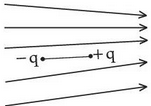
Figure below shows an electric dipole placed in an electric field. Which of the following statements is correct?
Answer & explanation
Correct answer: option 1
The correct answer is Option (1) → Torque \( \tau = 0 \) but net force is towards right
The torque on a dipole is \( \vec{\tau} = \vec{p}\times\vec{E} \), and the net force on it is the difference of the forces on its two charges. In a uniform field this difference is zero, but in a non-uniform field it is not.
Torque. The dipole moment points from \( -q \) to \( +q \), that is, to the right, along the field lines, so the angle between \( \vec{p} \) and \( \vec{E} \) is \( 0^\circ \).
\( \tau = pE\sin0^\circ = 0 \)
Force. In the figure the field lines come closer together towards the right, so the field is stronger on the right than on the left. The force on \( +q \) is \( qE_{\text{right}} \), towards the right, and the force on \( -q \) is \( qE_{\text{left}} \), towards the left. Since \( E_{\text{right}} \gt E_{\text{left}} \), the force on \( +q \) is the larger one:
\( F_{\text{net}} = q\,(E_{\text{right}} - E_{\text{left}}) \gt 0 \) — towards the right.
NCERT (2026-27):
Dipole in a Uniform External Field – “… What happens if the field is not uniform? In that case, the net force will evidently be non-zero. … In either case, the net torque is zero, but there is a net force on the dipole if E is not uniform. Figure 1.20 is self-explanatory. It is easily seen that when p is parallel to E, the dipole has a net force in the direction of increasing field.”