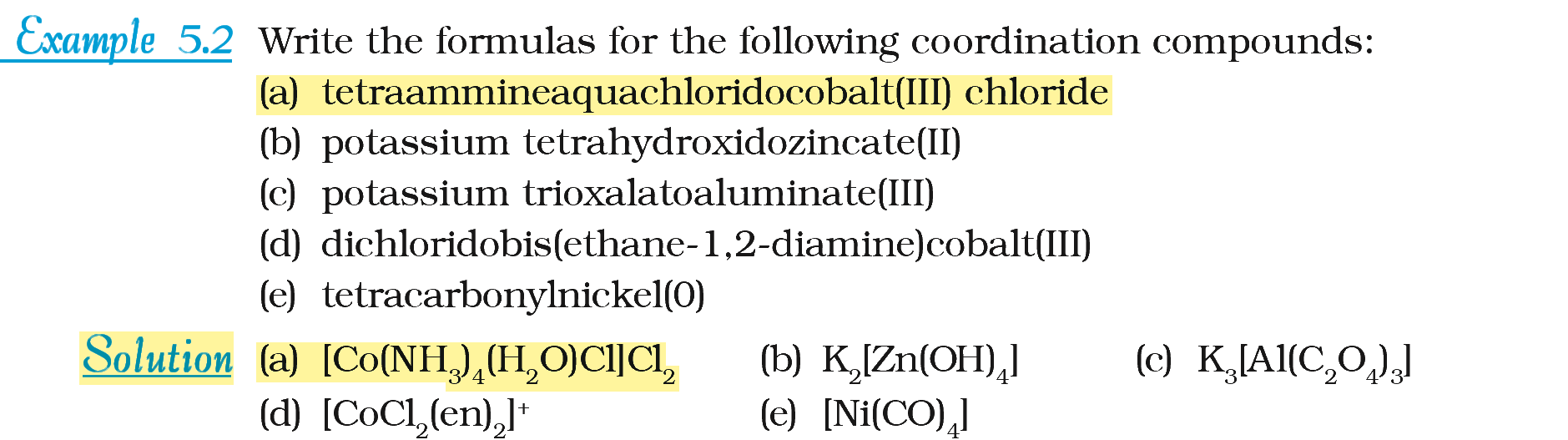
Match List - I with List - II.
|
List – I |
List – II |
|
(A) Tetracarbonylnickel(0) |
(I) \([CoCl_2(en)_2]^+\) |
|
(B) Tetraammineaquachloridocobalt(III) chloride |
(II) \(K_2[Zn(OH)_4]\) |
|
(C) Potassium tetrahydroxidozincate (II) |
(III) \([Co(NH_3)_4(H_2O)Cl]Cl_2\) |
|
(D) Dichloridobis(ethane-1,2-diamine)cobalt(III) |
(IV) \([Ni(CO)_4]\) |
Choose the correct answer from the options given below:
Answer & explanation
Correct answer: option 2
The correct answer is Option (2) → (A)-(IV), (B)-(III), (C)-(II), (D)-(I)
In an IUPAC name the ligands are named in alphabetical order before the metal, numbers of ligands are shown by di-, tri-, tetra- (bis-, tris- for complex ligands such as ethane-1,2-diamine), and the oxidation state of the metal follows in Roman numerals; an anionic complex ends in -ate (zincate).
(A) Tetracarbonylnickel(0) — This matches (IV) \([Ni(CO)_4]\). Four CO ligands on Ni in the zero oxidation state.
(B) Tetraammineaquachloridocobalt(III) chloride — This matches (III) \([Co(NH_3)_4(H_2O)Cl]Cl_2\). Four \( \ce{NH3} \), one \( \ce{H2O} \) and one \( \ce{Cl^{-}} \) inside the sphere: x + 0 + 0 − 1 = +2 (the charge balanced by two \( \ce{Cl^{-}} \) outside), so x = +3.
(C) Potassium tetrahydroxidozincate (II) — This matches (II) \(K_2[Zn(OH)_4]\). Four \( \ce{OH^{-}} \) on \( \ce{Zn^{2+}} \) give the anion \( \ce{[Zn(OH)4]^{2-}} \) (2 − 4 = −2), balanced by two \( \ce{K^{+}} \).
(D) Dichloridobis(ethane-1,2-diamine)cobalt(III) — This matches (I) \([CoCl_2(en)_2]^+\). Two \( \ce{Cl^{-}} \) and two neutral en on \( \ce{Co^{3+}} \): 3 − 2 = +1.
NCERT (2026-27 edition):
Naming of Mononuclear Coordination Compounds – …