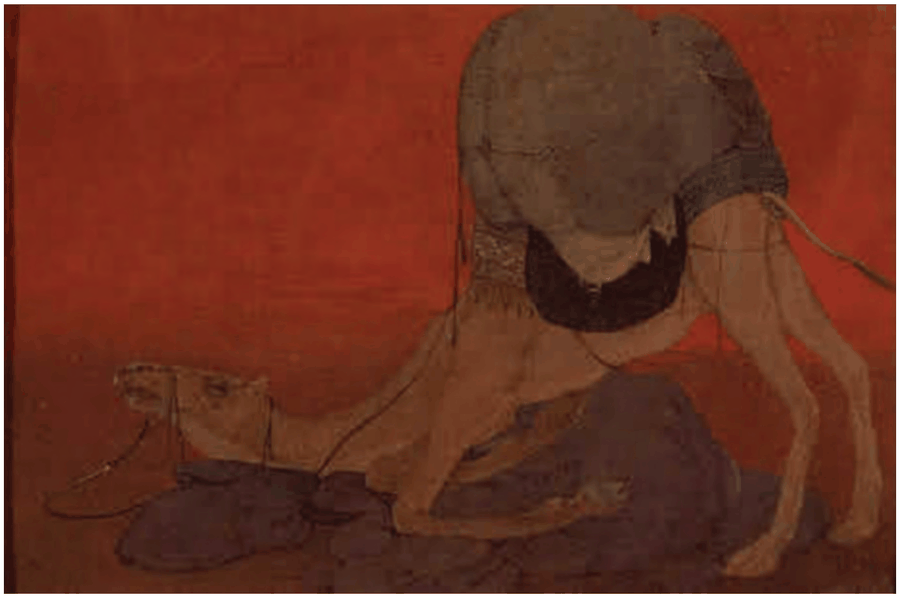
Which of the following statements about Abanindranath Tagore’s painting Journey’s End is NOT correct?
Answer & explanation
Correct answer: option 3
The correct answer is Option (3) → The wash technique in the painting yields a clear and defined landscape.
Option (1) The painting is in watercolour. — True of Journey’s End. Abanindranath made it in watercolour.
Option (2) Its painter, Abanindranath Tagore, invented the wash painting technique. — True of Journey’s End. He revived Indian and oriental traditions and invented the wash technique.
Option (3) The wash technique in the painting yields a clear and defined landscape. — Not true of Journey’s End. The wash gives a soft, misty and impressionistic landscape, used to suggest the end of a life.
Option (4) The collapsed camel in the painting personifies the end of a journey. — True of Journey’s End. The camel lies in a red background of dusk, so the end of a day stands for the end of a journey.
NCERT (2026-27): “Journey’s End Made by Abanindranath Tagore (1871–1951) in 1913, this painting is in watercolour. …The wash technique yields a soft, misty and impressionistic landscape. This quality of hazy and atmospheric effects of the wash are utilised to be suggestive or evocative of an end of a life. In this painting, a collapsed camel is shown in red background of dusk and in that sense it personifies the end of a journey through the end of a day.”
|