A person invested Rs. 10000 in a stock of a company for 6 years. The value of his investment at the end of each year is given in the following table:
| 2018 | 2019 | 2020 | 2021 | 2022 | 2023 |
| Rs. 11000 | Rs. 11500 | Rs. 13000 | Rs. 11800 | Rs. 12200 | Rs. 14000 |
The compound annual growth rate (CAGR) of his investment is:
[Given \((1.4)^{1/6} = 1.058\)]
Answer & explanation
Correct answer: option 1
The correct answer is Option (1) → 5.8%
The CAGR depends only on the beginning value, the ending value and the number of years; the values in between do not enter. Here the beginning value is Rs. 10000, the value at the end of 2023 is Rs. 14000, and n = 6 years.
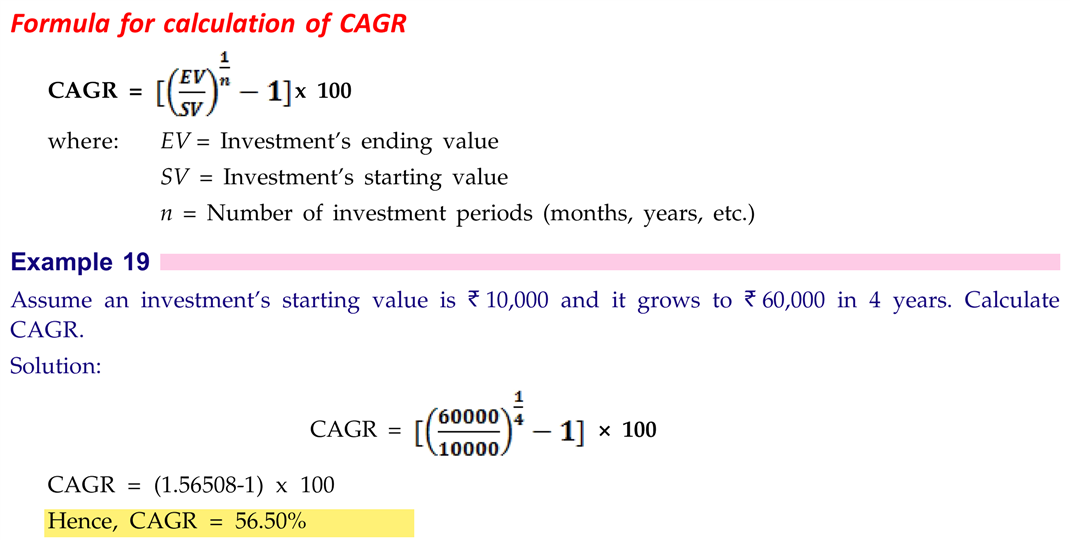
\( \displaystyle \text{CAGR} = \left(\frac{\text{Ending value}}{\text{Beginning value}}\right)^{1/n} - 1 \)
\( \displaystyle = \left(\frac{14000}{10000}\right)^{1/6} - 1 \)
\(= (1.4)^{1/6} - 1\)
\(= 1.058 - 1 = 0.058\)
So the CAGR is 5.8%.
CBSE Applied Mathematics (Class XII):
Compound Annual Growth Rate