
Amino acids are represented by the general structure 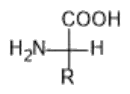 . Match the side chain ‘R’ given in List-I with the name of amino acid in List-II
| List-I | List-II |
| R | Amino acid |
(A) 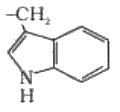 | (I) Tryptophan |
(B) 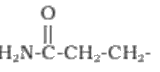 | (II) Arginine |
(C) 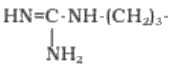 | (III) Asparagine |
(D) 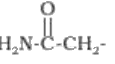 | (IV) Glutamine |
Choose the correct answer from the options given below:
Answer & explanation
Correct answer: option 2
The correct answer is Option (2) → (A) - (I), (B) - (IV), (C) - (II), (D) - (III)
All α-amino acids have an amino group and a carboxyl group on the same carbon atom, \( \ce{H2N-CH(R)-COOH} \). They differ only in the side chain R, so each amino acid is recognised by the group its side chain carries:
(A) Structure A — This matches (I) Tryptophan. The side chain is a \( \ce{CH2} \) group joined to an indole ring (a benzene ring fused to a five-membered ring containing N–H). Tryptophan is the only common amino acid with this ring.
(B) Structure B — This matches (IV) Glutamine. The side chain ends in an amide group (–\( \ce{CONH2} \)) separated from the α-carbon by two CH2 groups, R = –\( \ce{CH2CH2CONH2} \). Glutamine is the amide of glutamic acid.
(C) Structure C — This matches (II) Arginine. The side chain has three \( \ce{CH2} \) groups ending in a guanidino group, –NH–C(=NH)–NH2. This strongly basic group makes arginine a basic amino acid.
(D) Structure D — This matches (III) Asparagine. The side chain again ends in an amide group, but with only one CH2 group, R = –\( \ce{CH2CONH2} \). Asparagine is the amide of aspartic acid.
Shortcut: The pair (C)–(II) appears only in Option (2).