
CUETMOCK
  • Pricing
  • Mentors
Log inStart freeStart free mocks→

First test, then trust

Try a free CUET mock test.

Join 5,00,000+ students who rehearsed exam day on the exact NTA screen before sitting CUET. On the web and on Android.

Start free mocks →Get the Android app
CUETMOCK

India's #1 CUET Mock Test Platform. Original NCERT-based questions on the exact NTA exam screen — trusted by 5,00,000+ students since CUET 2022.

Get it onGoogle PlayScan to download the CUETMOCK app

Mock tests

  • CUET mock test series
  • Commerce mocks
  • Humanities (Arts) mocks
  • Science mocks
  • Languages & GAT mocks
  • Free practice questions
  • Pricing

Resources

  • CUET exam guide
  • CUET syllabus
  • Universities accepting CUET
  • Expert blogs
  • News & notifications
  • Webinars & counselling
  • CUET score calculator
  • How we estimate your rank
  • FAQs

Company

  • About us
  • Our leadership & team
  • Our toppers
  • Mentors
  • For schools
  • Contact us
  • Terms
  • Privacy
  • Refund policy

Talk to us

+91 7696 6630 56info@cuetmock.comWhatsApp us

Our other platforms

  • JEE Mock — For IIT-JEE aspirants
  • NEET Mock — For NEET aspirants

Newsletter

Exam updates, study material and offers — no spam.

© 2026 NYC Ventures Pvt. Ltd.

701-702, Royal Business Park, Zirakpur, Punjab - 140603

  • Terms of use
  • Privacy policy
  • Refund policy
  • Contact us

iCUETMOCK is an independent preparation platform, not affiliated with the National Testing Agency (NTA). Always check exam details on the official NTA website.

  • Home
  • Mock tests
  • CUET guide
  • Pricing
  • Log in
Home/Practice questions/Physics
PhysicsDual Nature of Radiation and Matter

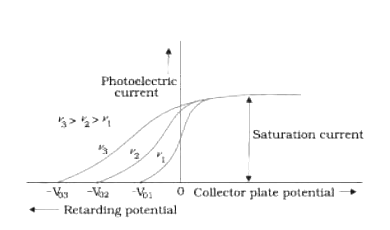
In the above figure the variation of photoelectric current with colle…

Figure for the question

In the above figure the variation of photoelectric current with collector plate potential is given. Choose the correct statements.

(A) The saturation current is constant for different frequencies of incident radiations.

(B) The intensity of the incident radiations is same for different frequencies.

(C) The stopping potential increases with the increase in frequency of incident radiations.

(D) The saturation current increases with the frequency of radiation.

Choose the correct answer from the options given below:

Answer & explanation+

Correct answer: option 1

The correct answer is Option (1) → (A), (B) and (C) only

The graph shows three curves for frequencies \( \nu_3 \gt \nu_2 \gt \nu_1 \). All three rise to the same saturation current, but each is cut off at a different stopping potential.

(A) The saturation current is constant for different frequencies of incident radiations. — Correct. The three curves level off at the same height.

(B) The intensity of the incident radiations is same for different frequencies. — Correct. Saturation current is proportional to the number of photoelectrons emitted per second, which depends on the intensity. Equal saturation currents mean the intensity is the same for all three frequencies.

(C) The stopping potential increases with the increase in frequency of incident radiations. — Correct. By Einstein’s photoelectric equation, a higher frequency gives a larger maximum kinetic energy, so a larger retarding potential is needed; the graph shows \( V_{03} \gt V_{02} \gt V_{01} \) for \( \nu_3 \gt \nu_2 \gt \nu_1 \).

    \( \displaystyle eV_0 = h\nu - \phi_0 \)

(D) The saturation current increases with the frequency of radiation. — Incorrect. The curves for different frequencies reach the same saturation current; frequency changes the stopping potential, not the saturation current.

NCERT (2026-27):
Effect of Frequency of Incident Radiation on Stopping Potential – “… We suitably adjust the same intensity of light radiation at various frequencies and study the variation of photocurrent with collector plate potential. The resulting variation is shown in Fig. 11.4. We obtain different values of stopping potential but the same value of the saturation current for incident radiation of different frequencies. … This implies that greater the frequency of incident light, greater is the maximum kinetic energy of the photoelectrons. Consequently, we need greater retarding potential to stop them completely.”
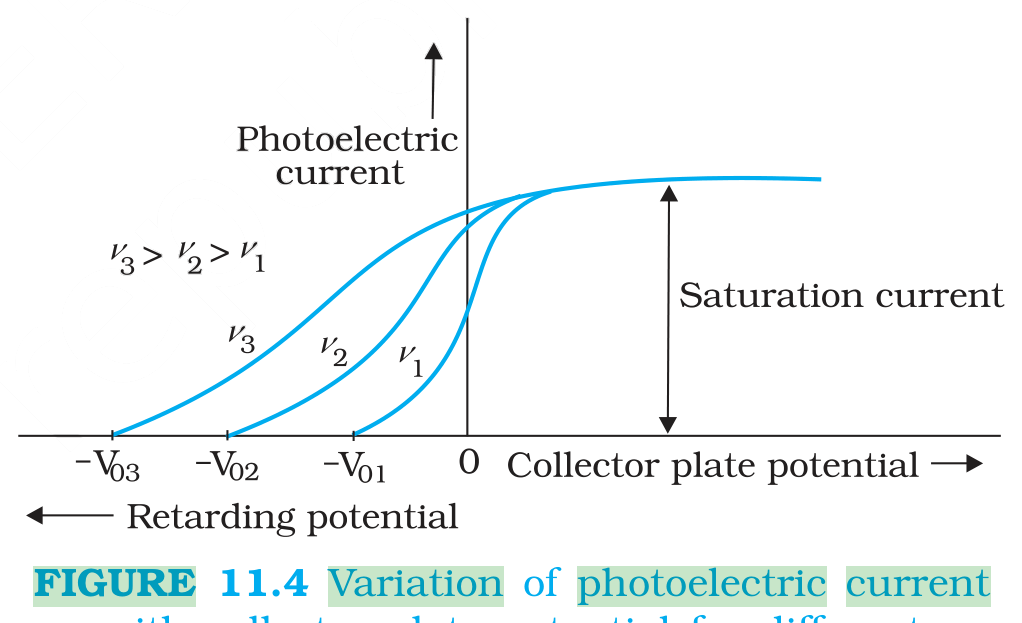
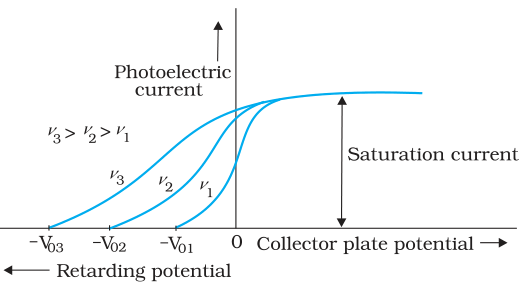
NCERT Fig. 11.4

Textbook figure

Advertisement

Practise more on Dual Nature of Radiation and Matter

Chapter-wise mocks on the real NTA exam screen, with solutions and your rank. Your first mocks are free.

Start free mocks →

Advertisement

Next questions

  1. Read the following statements, Assertion (A) and Reason (R): Assertion (A): External assistance is recorded in the capital account of the b…Economics · Macro Economics: Open Economy Macro Economics
  2. Article 23 of the Constitution of India prohibit which of the following?Legal Studies · Human Rights in India
  3. A bus goes to Akola from Mayapuri at a speed of 39 km/h for 70% of the journey, and covers the remaining past of its journey at the speed o…General Aptitude Test · Numerical Ability
  4. Match List - I with List - II :-List - IList - II(A)Rajendra Prasad(I)Chief Draughtsman(B)B.R. Ambedkar(II)President of the Constituent Ass…History · Modern India: Framing the Constitution
  5. Match List-I with List-II:List-IList-II(A) Allocation of resources(I) An organisation with some purpose(B) Opportunity cost(II) How much of…Economics · Micro Economics: Introduction
  6. Which of the following martial art forms is practiced in the state of Punjab and West Bengal?General Aptitude Test · General Knowledge
  7. Which one of the following pairs is incorrectly matched? Column 1 Column 2 1) ELISA a) Antigen-antibody interaction 2) Bt cotton b) Bacillu…Biology · Biotechnology and its Applications
  8. Modern Indian art grew out of nationalism, new attitudes and social concern. Match the description in List-I with the person it refers to i…Fine Arts · The Modern Indian Art
  9. What is included in economic planning?Business Studies · Business Environment
  10. After seals were found at Harappa, another excavator found similar seals at Mohenjodaro, far to the south. Which conjecture did this find l…History · Ancient India: Bricks, Beads and Bones