Read the following passage and answer the questions.
Suppose there is a market consisting of identical firms producing the same quality of salt.
Suppose the market demand curve and the market supply curve for salt are given by:
\( Q_D=350-p \) for \( 0 ≤ p ≤ 350 \)
= 0 for p > 350
\( Q_S = 220 + p \) for \( p ≥ 10 \)
= 0 for 0 ≤ p < 10
Where \( Q_D \) and \( Q_S \) denote the demand for and supply of salt (in kg) respectively and p denotes the price of salt per kg in rupees.
If demand for salt increases, and there is no change in the equilibrium price in the market, how does it affect the market?
Answer & explanation
Correct answer: option 1
The correct answer is Option (1) → Increase in demand increase in supply
The equilibrium price is the price at which quantity demanded equals quantity supplied. The question says demand rises, but this price does not change.
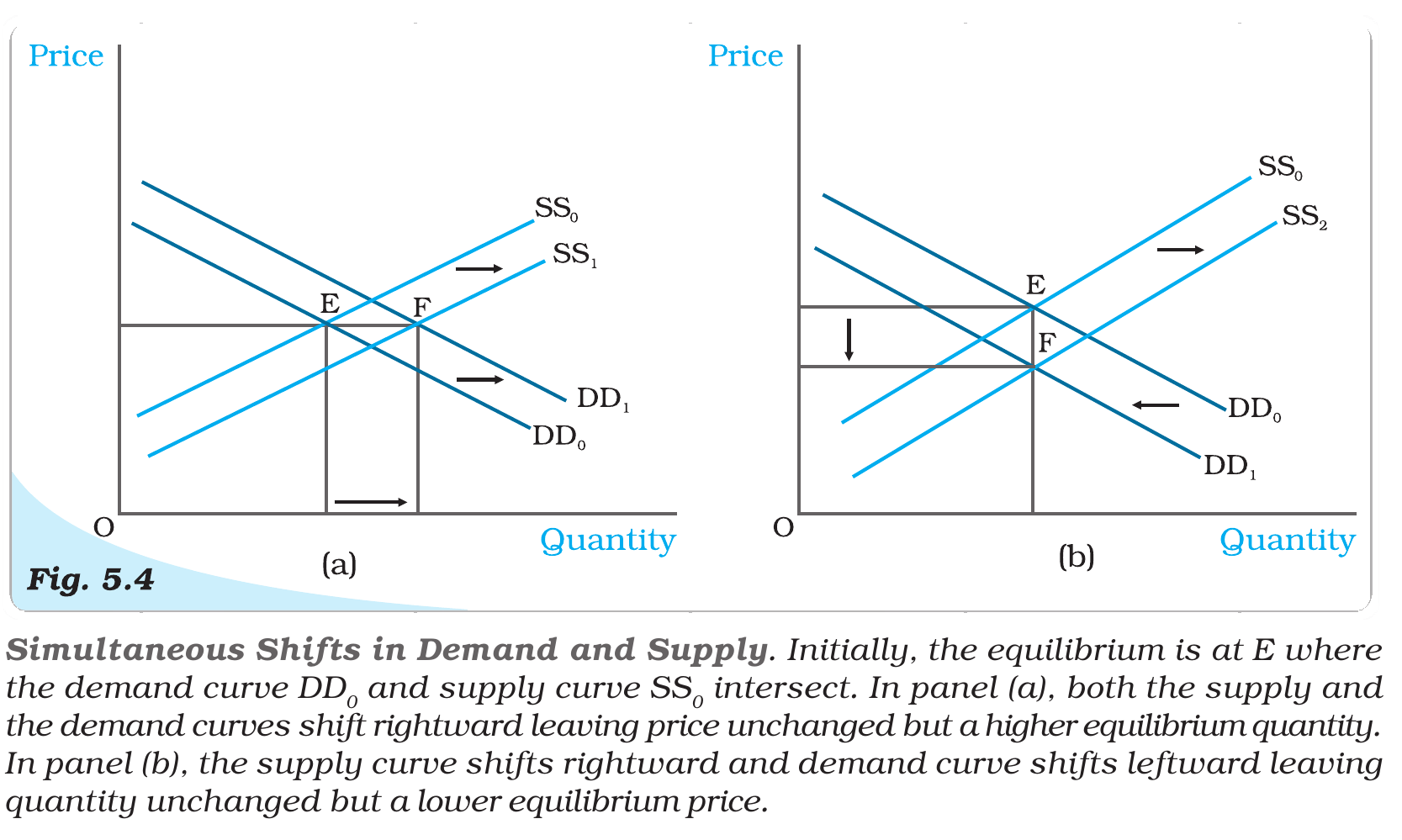
Option (1) Increase in demand increase in supply — Correct. An increase in demand shifts the demand curve to the right. At the old price, buyers now want more than sellers offer. This gap is called excess demand, and it pushes the price up. An equal rise in supply removes this gap, so the price stays where it was.
Option (2) Demand had increased but supply is unchanged. — Incorrect. Supply does not move, so there is excess demand at the old price and the price rises.
Option (3) Increase in demand = Decrease in supply — Incorrect. Both shifts push the price up, so the price must rise.
Option (4) Increase in demand is greater than Increase in supply — Incorrect. Supply rises too little, so some excess demand remains and the price still rises.
In the salt market of the passage, the equilibrium price is Rs 65 and the quantity is 285 kg. Suppose demand rises by 50 kg at every price.
New demand: \( Q_D = 400 - p \)
Supply must also rise by 50 kg: \( Q_S = 270 + p \)
Equilibrium: \( 400 - p = 270 + p \), so \( p = 65 \)
The price stays at Rs 65, and the quantity rises from 285 kg to 335 kg.
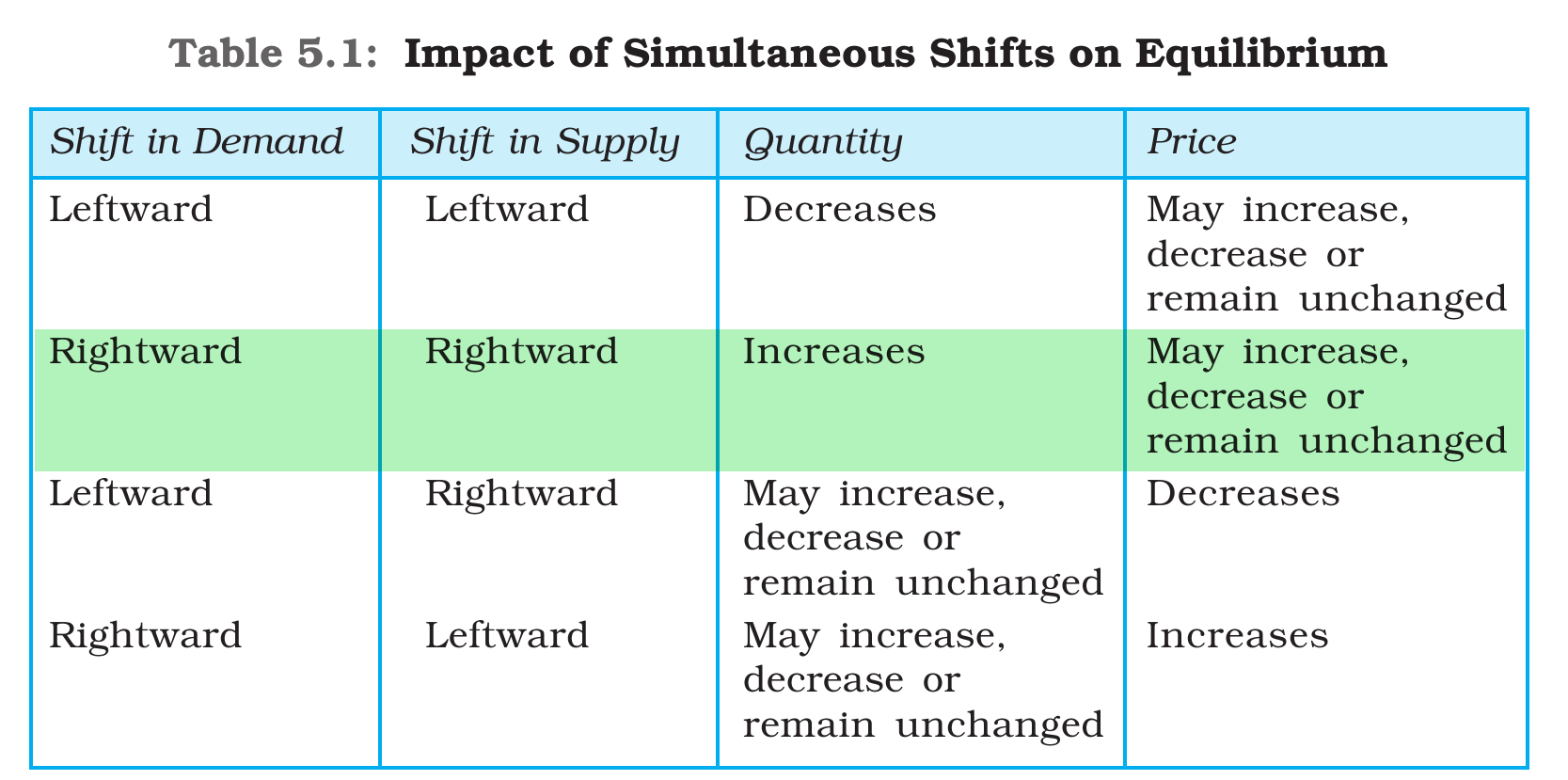
NCERT (2026-27): “Simultaneous Shifts of Demand and Supply What happens when both demand and supply curves shift simultaneously? … The impact on equilibrium price and quantity in all the four cases are given in Table 5.1. … For instance, from the second row of the table, we see that due to a rightward shift in both demand and supply curves, the equilibrium quantity increases invariably but the equilibrium price may either increase, decrease or remain unchanged. The actual direction in which the price will change will depend on the magnitude of the shifts. … In the next two cases, shown in the last two rows of the table, the effect on price is unambiguous whereas effect on quantity depends on the magnitude of shifts in the two curves. In the Figure 5.4(a), it can be seen that due to rightward shifts in both demand and supply curves, the equilibrium quantity increases whereas the equilibrium price remains unchanged…”
|