If 1 g of matter could be completely converted into energy, for how long could this energy run a power station of output \( 1000\,\mathrm{MW} \)? (Take \( c=3\times10^{8}\,\mathrm{m\,s^{-1}} \))
Answer & explanation
Correct answer: option 2
The correct answer is Option (2) → 25 h
When a mass \( m \) is fully changed into energy, the energy released is \( E=mc^2 \). This is Einstein’s mass–energy equivalence. A power station of output \( P \) uses up this energy in a time \( t=E/P \).
In SI units the data are:
\( m=1\,\mathrm{g}=10^{-3}\,\mathrm{kg} \)
\( P=1000\,\mathrm{MW}=10^{9}\,\mathrm{W} \)
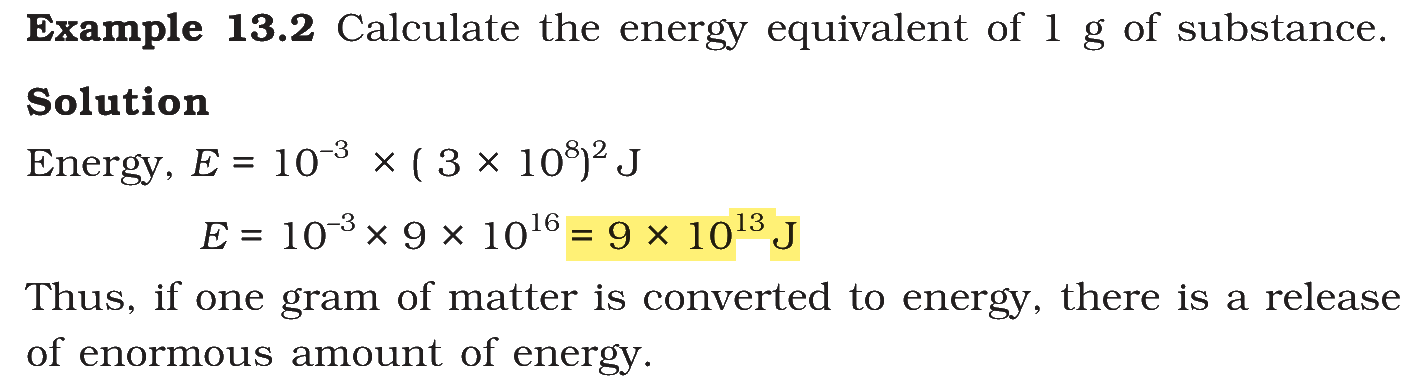
The energy from 1 g of matter is:
\( \begin{aligned} E &= mc^2 \\ &= 10^{-3}\,\mathrm{kg}\times(3\times10^{8}\,\mathrm{m\,s^{-1}})^2 \\ &= 9\times10^{13}\,\mathrm{J} \end{aligned} \)
The time for which it can run the station is:
\( \begin{aligned} t &= \frac{E}{P} \\ &= \frac{9\times10^{13}\,\mathrm{J}}{10^{9}\,\mathrm{W}} \\ &= 9\times10^{4}\,\mathrm{s} \end{aligned} \)
Converting to hours with \( 1\,\mathrm{h}=3600\,\mathrm{s} \):
\( \begin{aligned} t &= \frac{9\times10^{4}}{3600}\,\mathrm{h} \\ &= 25\,\mathrm{h} \end{aligned} \)
NCERT (2026-27):
Mass – Energy