Availability of special schools or segregated schooling for the differently abled may be understood as a measure of _______.
Answer & explanation
Correct answer: option 1
The correct answer is Option (1) → Social exclusion
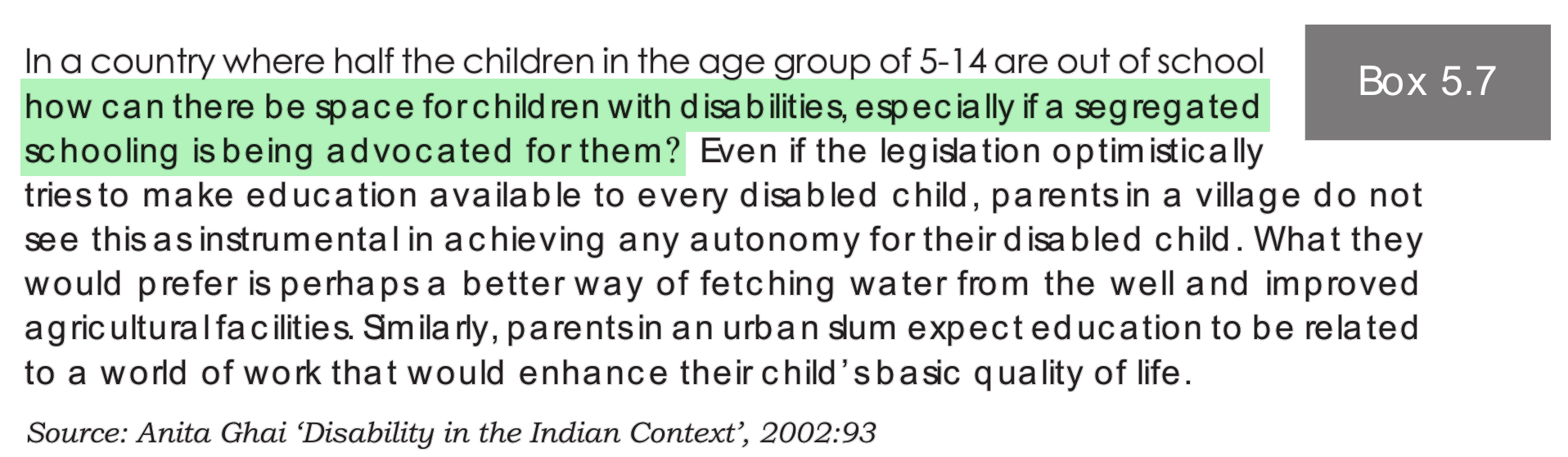
Option (1) Social exclusion — Correct. Social exclusion refers to the ways in which individuals may become cut off from full involvement in the wider society, without the opportunities open to the majority, education among them. Special or segregated schools keep differently abled children apart from the schools other children attend. Where segregated schooling is advocated for them, children with disabilities find no space in the common classroom; such schooling marks them off from the mainstream instead of including them.
Option (2) Social inclusion — Incorrect. Social inclusion is the opposite process: bringing people into the mainstream so that they share the same schools, jobs and public spaces as everyone else. Separate schools take children out of the common classroom, not into it.
Option (3) Discrimination — Incorrect. Discrimination refers to actual behaviour towards another group, as when a person is refused a job because of gender or religion. Providing a special school is not a refusal of an opportunity to a person; it is a separate arrangement that keeps a group apart.
Option (4) Prejudice — Incorrect. Prejudices are pre-conceived opinions or attitudes held by members of one group towards another. A prejudice is an attitude in the mind, whereas a school system is an arrangement of society.
NCERT (2025-26): “Social Exclusion Social exclusion refers to ways in which individuals may become cut off from full involvement in the wider society. It focuses attention on a broad range of factors that prevent individuals or groups from having opportunities open to the majority of the population. In order to live a full and active life, individuals must not only be able to feed, clothe and house themselves, but should also have access to essential goods and services such as education, health, transportation, insurance, social security, banking and even access to the police or judiciary. Social exclusion is not accidental but systematic – it is the result of structural features of society.…” “…Prejudices refer to pre-conceived opinions or attitudes held by members of one group towards another. The word literally means ‘pre-judgement’, that is, an opinion formed in advance of any familiarity with the subject, before considering any available evidence.…” “…If prejudice describes attitudes and opinions, discrimination refers to actual behaviour towards another group or individual. Discrimination can be seen in practices that disqualify members of one group from opportunities open to others, as when a person is refused a job because of their gender or religion.…”
Box 5.7 (NCERT 2025-26) |