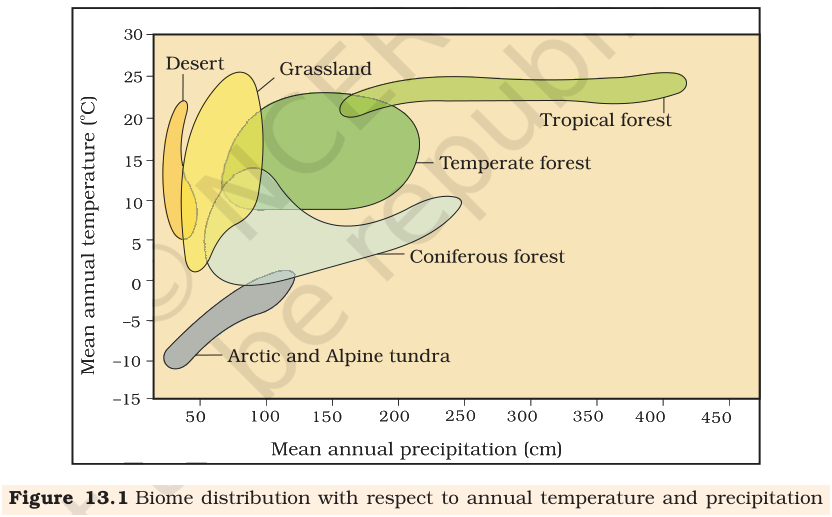
Answer the question from the given figure:
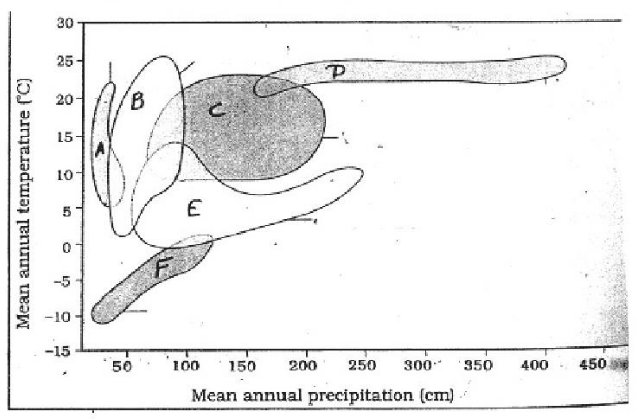
Identify the biomes with extreme and harsh habitats from the figure:
(A) B
(B) A
(C) F
(D) D
Choose the correct answer from the options given below:
Answer & explanation
Correct answer: option 4
The correct answer is Option (4) → (B) and (C)
The harshest habitats in the figure are the hot, dry desert (A) and the very cold tundra (F).
Option (1) (A) and (D) — Incorrect. B is grassland and D is tropical forest, both mild.
Option (2) (A) and (B) — Incorrect. B (grassland) is not extreme.
Option (3) (C) and (D) — Incorrect. D (tropical forest) is not extreme.
Option (4) (B) and (C) — Correct. Deserts (very dry and hot) and tundra (very cold) are the biomes with the most extreme and harsh conditions. In the figure these are A (desert) and F (tundra), given in the paper as (B) and (C).
Note: This question is from the topic “Organism and Its Environment” in Chapter 13, Organisms and Populations, of the pre-rationalised NCERT book. This portion is not in the present NCERT book, where the chapter is now Chapter 11, Organisms and Populations. The extract below is from the pre-rationalised edition.
NCERT Extract (Pre-rationalised edition, Chapter 13, Organisms and Populations):
Organism and Its Environment – “… Ecology at the organismic level is essentially physiological ecology which tries to understand how different organisms are adapted to their environments in terms of not only survival but also reproduction. You may have learnt in earlier classes how the rotation of our planet around the Sun and the tilt of its axis cause annual variations in the intensity and duration of temperature, resulting in distinct seasons. These variations together with annual variation in precipitation (remember precipitation includes both rain and snow) account for the formation of major biomes such as desert, rain forest and tundra (Figure 13.1).”