
Reduction of nitrobenzene by which of the following reagent does not give aniline?
Answer & explanation
Correct answer: option 4
The correct answer is Option (4) → $Sn/NH_4OH$
Core Concept
Acidic reduction of nitrobenzene gives aniline, whereas reduction in alkaline medium gives different products (like azoxybenzene, hydrazobenzene, etc.).
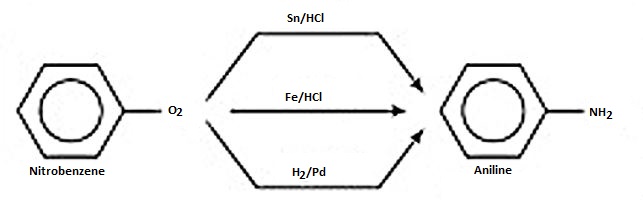
Option 1 (Sn/HCI)
This is a classic reducing system used for converting nitro compounds into amines. Tin in the presence of hydrochloric acid provides nascent hydrogen which reduces the nitro group ($- NO_2$) completely to an amino group ($-NH_2$). Therefore, nitrobenzene gets converted into aniline.
Option 2 (Fe/HCI)
Iron filings with hydrochloric acid also act as a strong reducing system in acidic medium. This combination reduces the nitro group stepwise through intermediates like nitroso and hydroxylamine to finally produce aniline. Hence, this reagent gives aniline.
Option 3 ($H_2-Pd$)
Catalytic hydrogenation using palladium as catalyst reduces nitrobenzene directly to aniline. Hydrogen gas adds across the nitro group and converts it into an amino group efficiently. Therefore, aniline is formed.
Option 4 ($Sn/NH_4OH$)
This reduction occurs in alkaline medium, not acidic medium. In alkaline conditions, nitrobenzene does not reduce fully to aniline but instead forms products like azoxybenzene, azo compounds, or hydrazo derivatives. Hence, this reagent does not give aniline.