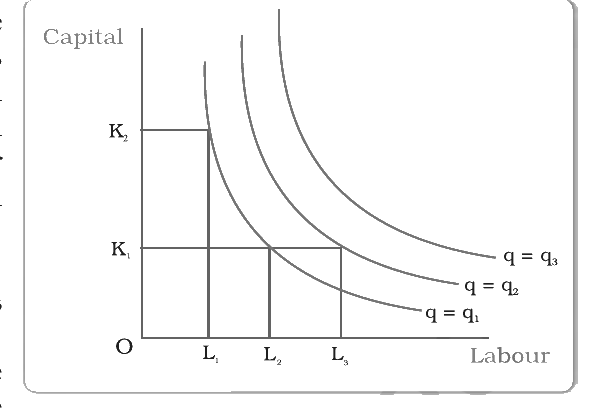
If we fix capital at K1 and increase the amount of labour employed, then what will happen?
Answer & explanation
Correct answer: option 4
The correct answer is Option (4) → Both (1) and (3)
Capital stays at K1 and labour rises. With more of one input and no less of the other, output increases, so the firm moves to a higher isoquant.
Option (1) We will reach a higher isoquant — Correct statement, but it is only one of the correct points, so on its own it is not the answer.
Option (2) We will reach a lower isoquant — Incorrect. A lower isoquant means less output, but output rises here.
Option (3) Level of output increases — Correct statement, but it is only one of the correct points, so on its own it is not the answer.
NCERT (2026-27): “Isoquant … The diagram here generalizes this concept. We place L on the X axis and K on the Y axis. We have three isoquants for the three output levels, namely q = q1, q = q2 and q = q3. Two input combinations (L1, K2) and (L2, K1) give us the same level of output q1. If we fix capital at K1 and increase labour to L3, output increases and we reach a higher isoquant, q = q2. When marginal products are positive, with greater amount of one input, the same level of output can be produced only using lesser amount of the other. Therefore, isoquants are negatively sloped.”
|