
The figure shows a galvanic cell.
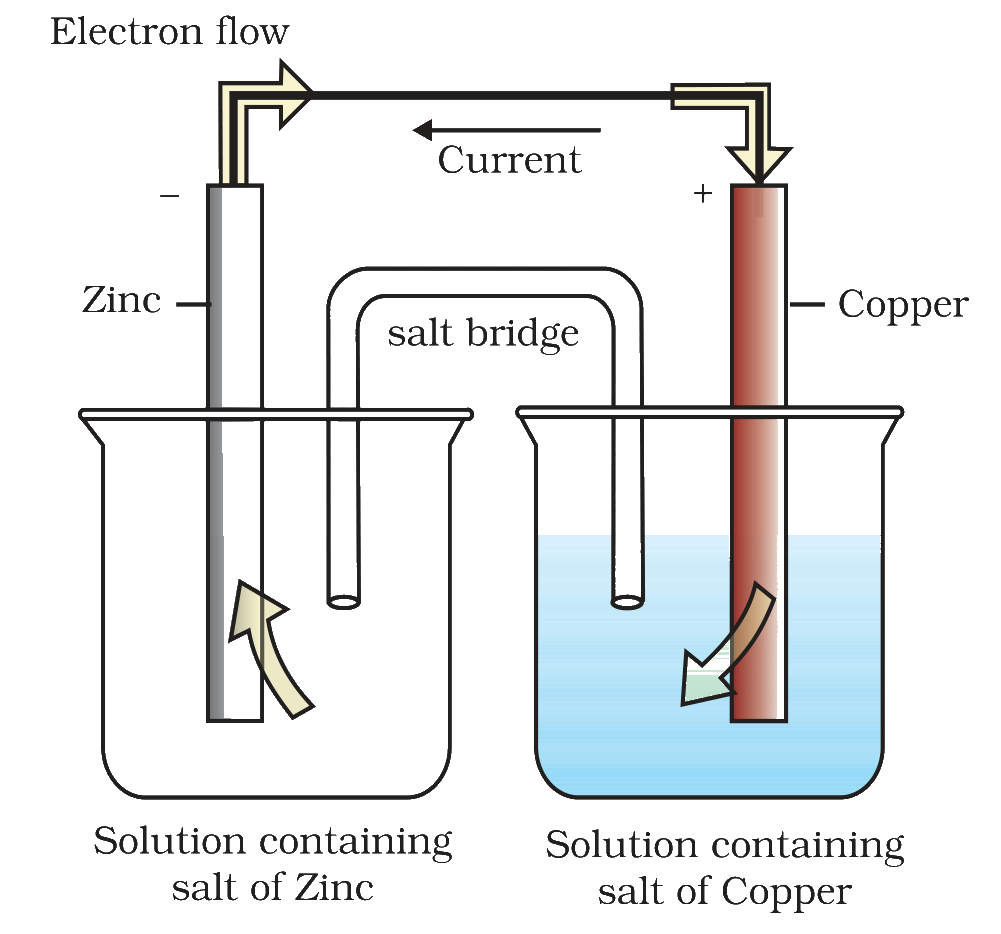
As the cell works, which electrode loses mass, and why?
Answer & explanation
Correct answer: option 2
The correct answer is Option (2) → Zinc, because zinc atoms are oxidised and pass into the solution as Zn2+ ions
The arrow in the figure shows electrons flowing from the zinc rod to the copper rod in the external circuit. Electrons leave the electrode at which oxidation occurs, so zinc atoms are oxidised and pass into the solution as Zn2+ ions, and the zinc electrode loses mass. At the copper electrode, Cu2+ ions take up these electrons and are deposited as copper.
Zinc electrode: \( \ce{Zn(s) -> Zn^2+ + 2e^-} \)
Copper electrode: \( \ce{Cu^2+ + 2e^- -> Cu(s)} \)
Why the other options are incorrect
Option (1) Copper, because Cu2+ ions from the solution are deposited on it — Incorrect. Deposition of Cu2+ ions adds mass to the copper electrode; it does not remove it.
Option (3) Copper, because copper atoms are oxidised and pass into the solution as Cu2+ ions — Incorrect. Electrons flow towards copper, so reduction, not oxidation, occurs on the copper electrode, and it gains mass.
Option (4) Zinc, because Zn2+ ions from the solution are deposited on it — Incorrect. Zn2+ ions are formed at the zinc electrode; they are not deposited on it.
NCERT (2026-27 edition):
2.2 Galvanic Cells – “…This reaction is a combination of two half reactions whose addition gives the overall cell reaction:”
(i) Cu2+ + 2e– → Cu(s) (reduction half reaction) (2.2)
(ii) Zn(s) → Zn2+ + 2e– (oxidation half reaction) (2.3)
“These reactions occur in two different portions of the Daniell cell. The reduction half reaction occurs on the copper electrode while the oxidation half reaction occurs on the zinc electrode.”
Fig. 2.1: Daniell cell having electrodes of zinc and copper dipping in the solutions of their respective salts.