Which statement is not correct about the Security Council of UN?
Answer & explanation
Correct answer: option 3
The correct answer is Option (3) → The ten members (non-permanent) are elected by a process of voting in the Security Council
Option (1) There are fifteen members — True. The Security Council has five permanent members and ten non-permanent members, fifteen in all.
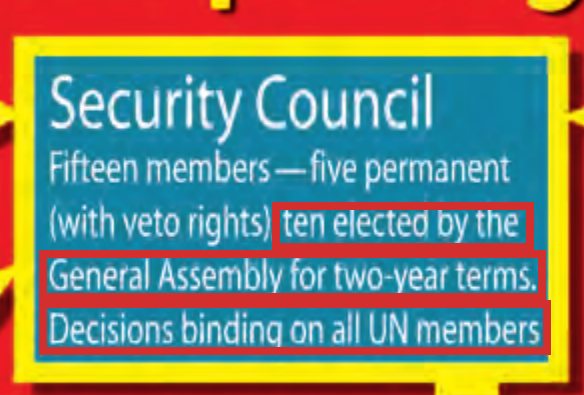
Option (2) The decision of the Security Council is binding on all UN members — True. All members of the UN have agreed to accept and carry out the decisions of the Security Council (see the UN System chart below).
Option (3) The ten members (non-permanent) are elected by a process of voting in the Security Council — False. The non-permanent members serve for two years and are elected so that they represent all continents of the world, but they are elected by the General Assembly, not by a vote in the Security Council itself.
Option (4) There are five permanent members — True. The Security Council has five permanent members, whose main privileges are permanency and the veto power.
NCERT (2026-27): “Reform of Structures and Processes … In the Security Council, there are five permanent members and ten non-permanent members. The Charter gave the permanent members a privileged position to bring about stability in the world after the Second World War. The main privileges of the five permanent members are permanency and the veto power. The non-permanent members serve for only two years at a time and give way after that period to newly elected members. A country cannot be re-elected immediately after completing a term of two years. The non-permanent members are elected in a manner so that they represent all continents of the world. Most importantly, the non-permanent members do not have the veto power. What is the veto power? In taking decisions, the Security Council proceeds by voting. All members have one vote. However, the permanent members can vote in a negative manner so that even if all other permanent and non-permanent members vote for a particular decision, any permanent member’s negative vote can stall the decision. This negative vote is the veto.…”
Chart ‘The United Nations System’, chapter ‘International Organisations’ (2026-27): Security Council – fifteen members, five permanent (with veto rights), ten elected by the General Assembly for two-year terms; Decisions binding on all UN members (boxed in red) |