Solids have definite mass, volume and shape. Depending upon order, they are classified as crystalline solids and amorphous solids. Crystalline solids are further classified into molecular, ionic, metallic and covalent solids. Crystalline solids are made up of constituent particles which are arranged in a regular pattern, which is depicted in the form of three dimensional array of points in spaces called lattice points. Small characteristic repeating portion of lattice is called unit cell.
Unit cells can be primitive and also centred unit cells like face centred, body centred, end centred. Solids are not perfect. There are various types of defects (i) line defect (ii) point defect. Point defects are of three types : stoichiometric, impurity and non-stoichiometric defects. Solids show magnetic properties depending upon the orientation of electron.
Based on the paragraph Answer the following :
Identify the type of magnetic property from the schematic alignment of magnetic moment given below :

Answer & explanation
Correct answer: option 4
The correct answer is Option (4) → Ferrimagnetic
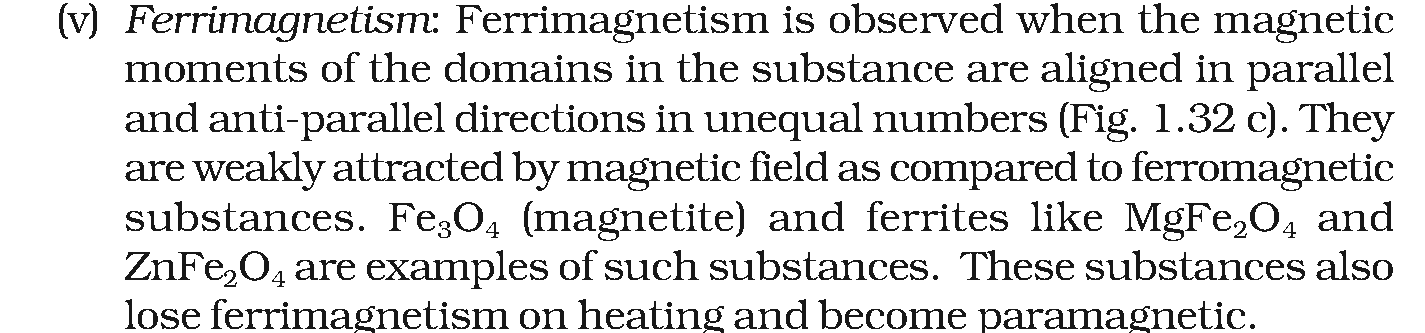
The figure shows the magnetic moments of the domains pointing in opposite directions (parallel and anti-parallel), but not in equal numbers: four point up and two point down. Such an arrangement leaves a small net magnetic moment, and this is ferrimagnetism. Examples: magnetite (\( \ce{Fe3O4} \)) and ferrites such as \( \ce{MgFe2O4} \) and \( \ce{ZnFe2O4} \).
Why the other options are incorrect
Option (1) Diamagnetic — Incorrect. All electrons are paired, so there are no magnetic moments to align; such substances are weakly repelled by a magnetic field.
Option (2) Ferromagnetic — Incorrect. All the domain moments point in the same direction (↑↑↑↑↑↑), giving a strong net moment.
Option (3) Antiferromagnetic — Incorrect. The moments are opposed in equal numbers (↑↓↑↓↑↓), so they cancel completely and the net moment is zero.
Note: This question is from the pre-rationalised NCERT book (2022-23). The topic is not there in the latest NCERT book (2026-27), and it is also out of the CUET 2026 syllabus.
NCERT (Pre-rationalised edition, 2022-23):
Ferrimagnetism