Which of the following is a gem-dihalide?
Answer & explanation
Correct answer: option 2
The correct answer is Option (2) → Ethylidene chloride
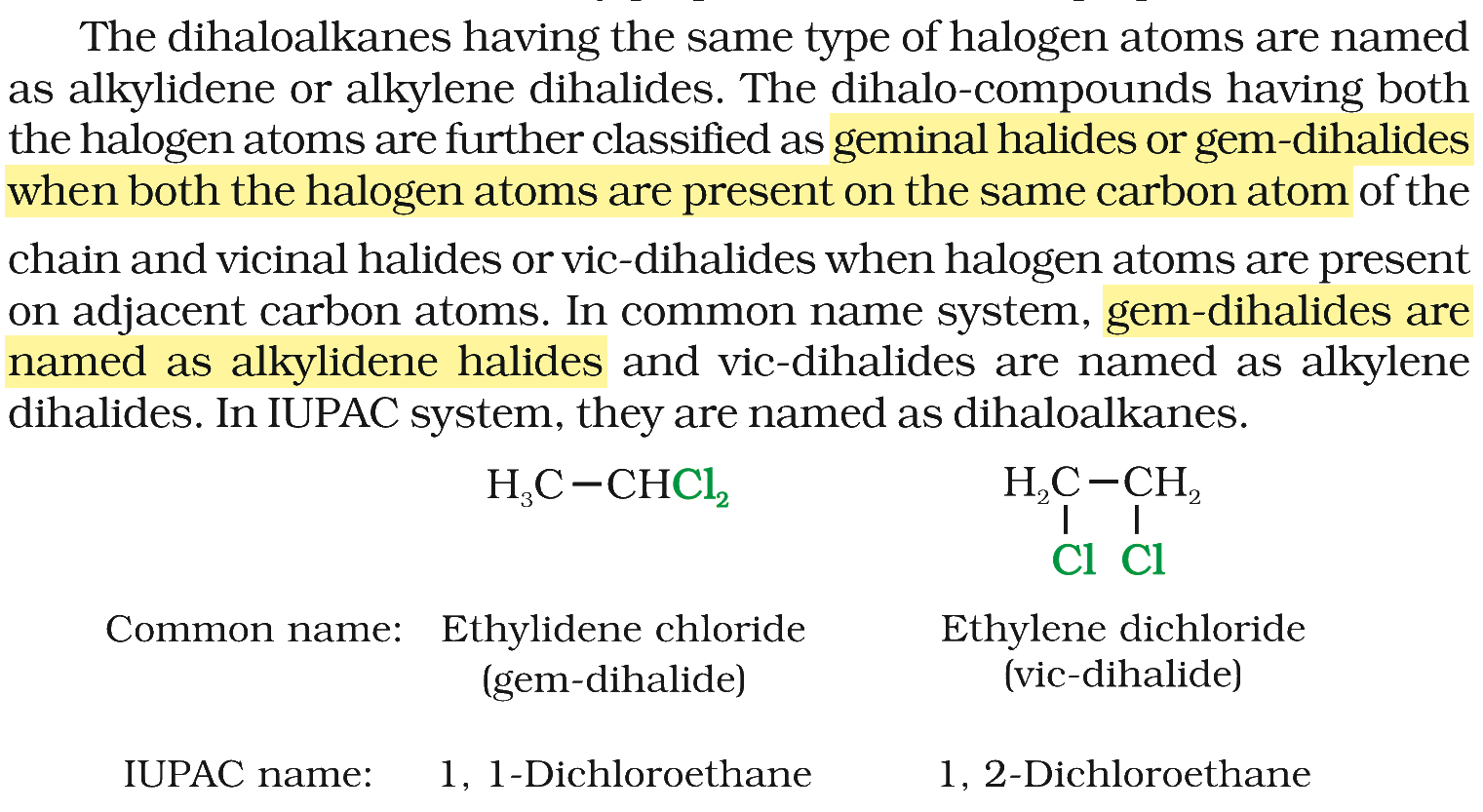
A dihalide is geminal (gem) when both halogen atoms are on the same carbon atom, and vicinal (vic) when they are on adjacent carbon atoms. In common names, gem-dihalides are called alkylidene halides and vic-dihalides alkylene dihalides.
Ethylidene chloride is \( \ce{CH3CHCl2} \) (1,1-dichloroethane): both Cl atoms are on C-1, so it is the gem-dihalide.
Why the other options are incorrect
Option (1) Ethylene dichloride — Incorrect. \( \ce{ClCH2-CH2Cl} \) has the Cl atoms on neighbouring carbons, so it is a vic-dihalide.
Option (3) 1,2-Dichloropropane — Incorrect. \( \ce{CH3-CHCl-CH2Cl} \) is also a vic-dihalide (C-1 and C-2).
Option (4) 1,3-Dichloropropane — Incorrect. \( \ce{ClCH2-CH2-CH2Cl} \) has the Cl atoms on C-1 and C-3, neither on the same nor on adjacent carbons, so it is neither gem nor vic.
NCERT (2026-27 edition):
Nomenclature – …