
CUETMOCK
  • Pricing
  • Mentors
Log inStart freeStart free mocks→

First test, then trust

Try a free CUET mock test.

Join 5,00,000+ students who rehearsed exam day on the exact NTA screen before sitting CUET. On the web and on Android.

Start free mocks →Get the Android app
CUETMOCK

India's #1 CUET Mock Test Platform. Original NCERT-based questions on the exact NTA exam screen — trusted by 5,00,000+ students since CUET 2022.

Get it onGoogle PlayScan to download the CUETMOCK app

Mock tests

  • CUET mock test series
  • Browse all papers
  • Commerce mocks
  • Humanities (Arts) mocks
  • Science mocks
  • Languages & GAT mocks
  • Free practice questions
  • Pricing

Resources

  • CUET exam guide
  • CUET syllabus
  • Universities accepting CUET
  • Expert blogs
  • News & notifications
  • Webinars & counselling
  • CUET score calculator
  • How we estimate your rank
  • FAQs

Company

  • About us
  • Our leadership & team
  • Our toppers
  • Mentors
  • For schools
  • Contact us
  • Terms
  • Privacy
  • Refund policy

Talk to us

+91 7696 6630 56info@cuetmock.comWhatsApp us

Our other platforms

  • JEE Mock — For IIT-JEE aspirants
  • NEET Mock — For NEET aspirants

Newsletter

Exam updates, study material and offers — no spam.

© 2026 NYC Ventures Pvt. Ltd.

701-702, Royal Business Park, Zirakpur, Punjab - 140603

  • Terms of use
  • Privacy policy
  • Refund policy
  • Contact us

iCUETMOCK is an independent preparation platform, not affiliated with the National Testing Agency (NTA). Always check exam details on the official NTA website.

  • Home
  • Mock tests
  • CUET guide
  • Pricing
  • Log in
Home/Practice questions/Maths. Section B1
Maths. Section B1Three-dimensional Geometry

The image of the point (1, 3, 4) in the plane 2x – y + z + 3 = 0 is :

The image of the point (1, 3, 4) in the plane 2x – y + z + 3 = 0 is :

Answer & explanation+

Correct answer: option 1

As it is clear from the figure that PQ will be perpendicular to the plane and foot of this perpendicular is mid point of PQ i.e. N.
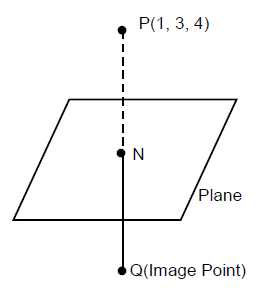
So, direction ratios of line PQ is 2, –1, 1

⇒ Equation of line PQ = $\frac{x-1}{2}=\frac{y-3}{-1}=\frac{z-4}{1}$ r (say)

Any point on line PQ is (2r + 1, –r + 3, r + 4)

If this point lies on the plane, then

2(2r + 1) – (–r + 3) + (r + 4) + 3 = 0 ⇒ r = –1

∴ coordinate of foot of perpendicular N = (–1, 4, 3)

As N is middle point of PQ

∴ $-1=\frac{1+x_1}{2}, 4=\frac{3+y_1}{2}, 3=\frac{4+z_1}{2}$

⇒ x1 = –3, y1 = 5, z1 = 2

∴ Image of point P (1, 3, 4) is the point Q (–3, 5, 2).

Advertisement

Practise more on Three-dimensional Geometry

Chapter-wise mocks on the real NTA exam screen, with solutions and your rank. Your first mocks are free.

Start free mocks →

Advertisement

Next questions

  1. Let A be a square matrix of order 3 such that |A| = 3 . Then the value of |adj(2A)| isMaths. Section A · Determinants (Section A)
  2. Which of the following gives rise to different levels in an organisation?Business Studies · Nature and significance of Management
  3. The lengths of the three sides of a triangle are 3 cm, 4 cm and 5 cm respectively. Find the area of this triangle.General Aptitude Test · Quantitative Reasoning
  4. Select the most appropriate word for the given group of words. A large crowd of people intent on causing trouble or violenceEnglish · One Word
  5. Which of the following statements about black soil is INCORRECT?General Aptitude Test · General Knowledge
  6. The value of ∫_1^2(x+1)/(x^2) dx isMaths. Section B1 · Definite Integration
  7. Which of the following Odissi dancers is also a master of percussion instruments like Mridangam, Pakhavaj and Tabla?General Aptitude Test · General Knowledge
  8. The bidi making industry uses the leaves of:Sociology · Social Change and Development in India: Change and Development in industrial Society
  9. Which among the following statement is incorrect regarding inbreeding?Biology · Strategies for enhancement in Food production
  10. The compound [C] formed can be prepared from reaction of alc. KOH with:Chemistry · Organic: Aldehydes, Ketones and Carboxylic Acids